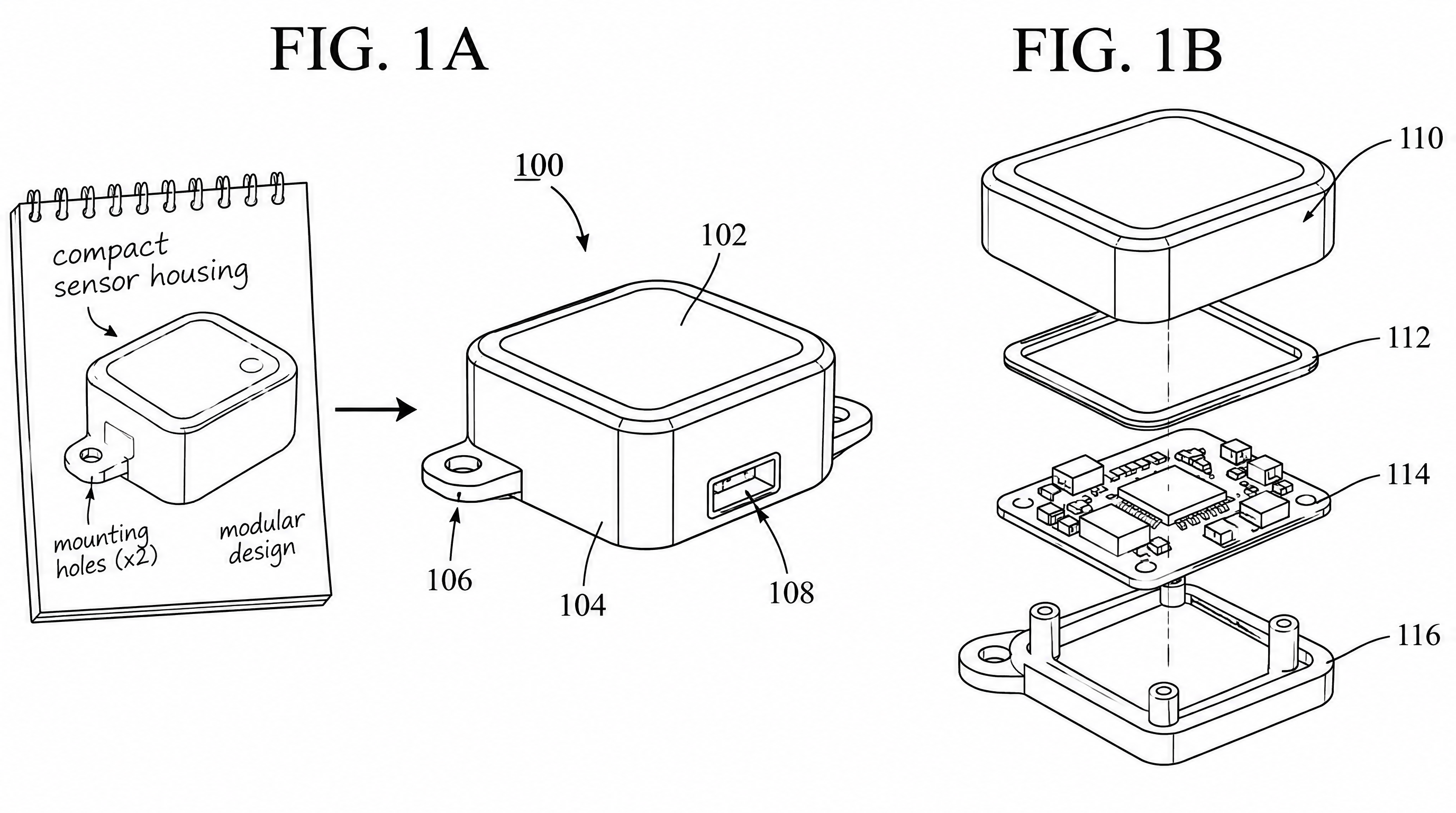
Prototype or Patent First? A Practical Hardware Filing Guide for Founders (2026)
Prototype or patent first? Learn why you do not need a physical patent prototype under 35 U.S.C. 112(a), when to file a provisional first, and how to turn a rough concept into patent drawings that impress investors.
TL;DR: When deciding whether to prototype or patent first, remember that patent law does not require a physical model. Under 35 U.S.C. § 112(a), filing a thorough written description with clear, numbered drawings counts as constructive reduction to practice — giving you the exact same legal footing at the USPTO as a working benchtop build. File a provisional application first whenever your core mechanism works on paper and you are approaching public demos, supplier RFQs, or fundraising; build a confidential benchtop prototype first only when you are unsure whether the underlying mechanism will physically work at all.
Ready to lock your priority date before sending files to a shop or pitching investors? Turn notebook sketches or CAD views into numbered patent line art in minutes in the PatentFig AI generator.
Prototype or Patent First? Constructive vs. Actual Reduction to Practice
One of the most persistent myths in hardware entrepreneurship is the question: do you need a prototype to get a patent? In modern patent practice, the answer is almost always no.
The USPTO stopped requiring physical patent models for routine inventions back in 1880 (retaining the right to request working models only for extraordinary cases such as alleged perpetual-motion machines under 35 U.S.C. § 114). Today, U.S. patent law recognizes two equally valid ways to establish that an invention is complete:
- Actual reduction to practice: Building a physical patent prototype and testing it under conditions that prove it performs its intended function.
- Constructive reduction to practice: Filing a patent application whose specification and drawings satisfy the enablement and written description standards of 35 U.S.C. § 112(a) — meaning an engineer of ordinary skill in your field could build and operate the device from your filing without "undue experimentation" (see MPEP 2164).
Because the United States (since the America Invents Act) and every major foreign patent office operate under a first-inventor-to-file rule, waiting six months to machine aluminum housings before filing does not strengthen your legal priority. Instead, every week spent waiting increases the risk that an independent competitor files first, or that an accidental public disclosure bars your foreign patent rights altogether.
Decision Matrix: File First vs. Prototype First vs. The Iterative Provisional Loop
Choosing whether to build a patent prototype or file first comes down to two variables: technical uncertainty (do you know how to build it?) and disclosure pressure (how soon will outsiders see it?).
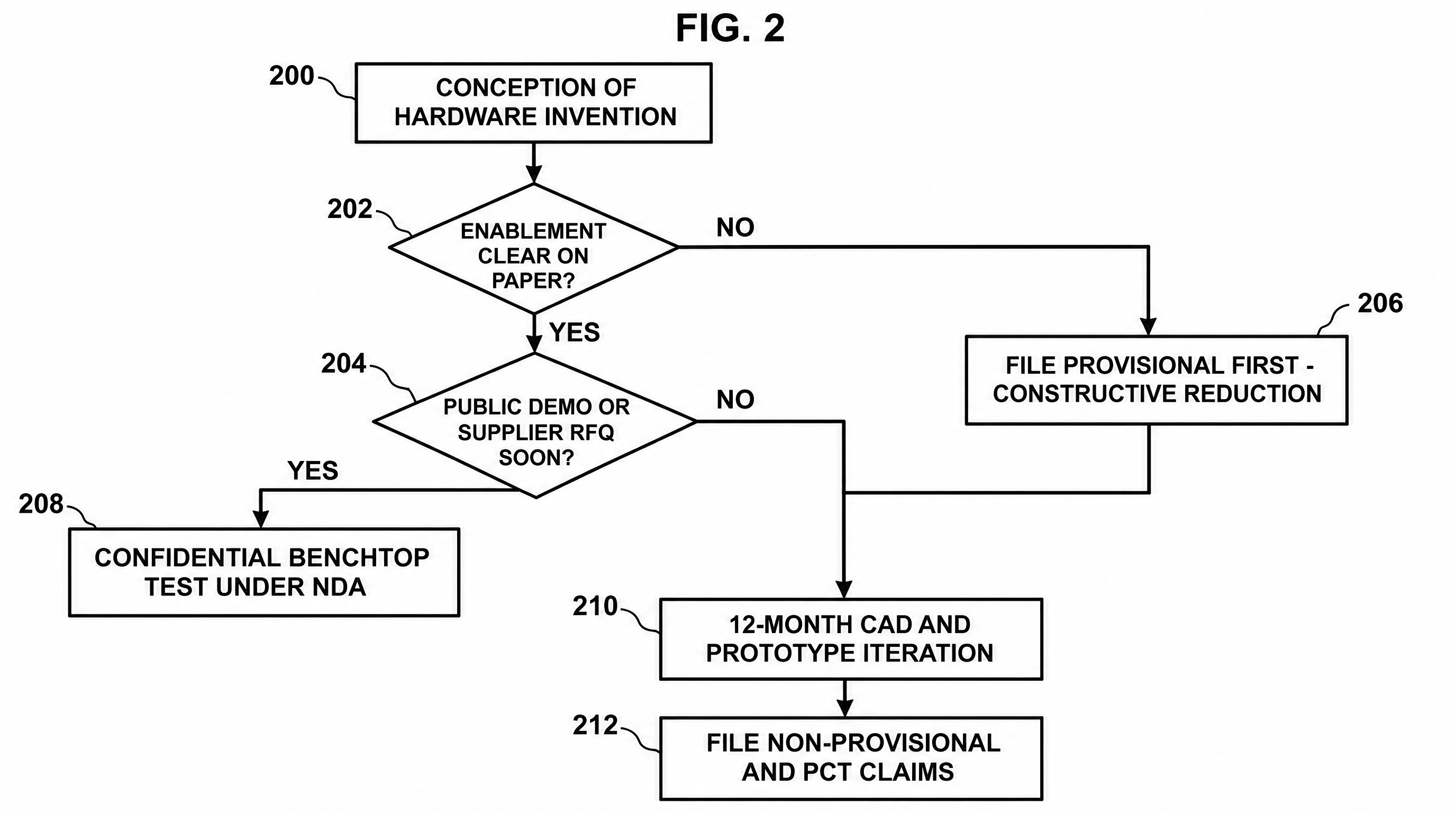
Use the matrix below to match your hardware stage to the safest filing sequence:
| Scenario | Recommended Sequence | Why It Works (US vs. Global Rules) |
|---|---|---|
| Clear mechanism + upcoming Kickstarter, trade show, or public video | Patent First (File US Provisional before publishing a single photo or render) | Public disclosure before filing forfeits novelty at the EPO (no general grace period); CNIPA allows only a narrow 6-month exception; JPO and KIPO grant 12 months only with a formal grace-period claim. Even in the US, the 1-year grace period under 35 U.S.C. § 102(b)(1) is a defensive last resort, not a global strategy. |
| Sending 3D print files or RFQs to contract manufacturers | Patent First + signed NNN/NDA agreement | Supplier leaks and informal quoting portals create murky on-sale and public-use disputes. A provisional filing date timestamps exactly what belonged to you before parts left your desk. |
| High physics, materials, or fluidic uncertainty | Confidential Prototype First (Benchtop proof-of-concept behind closed doors) | If a speculative mechanism turns out to violate thermal or mechanical limits, a premature provisional teaches a non-working embodiment that will not support your eventual claims. Test privately, then file immediately once the core geometry works. |
| Active Venture / Seed hardware development over 6–12 months | Iterative Provisional Loop (Day-1 Provisional → Prototyping → Rolling Provisionals → Month-12 Non-Provisional) | Gives you an immediate Day-1 priority date for the foundational architecture while capturing newly discovered latch geometries, seals, or sensor layouts before converting at Month 12. |
For most venture-backed or bootstrapped product teams, the Iterative Provisional Loop resolves the "prototype or patent first" dilemma completely. Rather than treating patenting and prototyping as mutually exclusive, you file a well-illustrated provisional application on Day 1 for under a few hundred dollars in USPTO micro- or small-entity fees, then spend the next 11 months building, testing, and refining physical prototypes under that priority umbrella.
Concrete Patent Idea Example: From Day-1 Sketch to Month-12 Non-Provisional
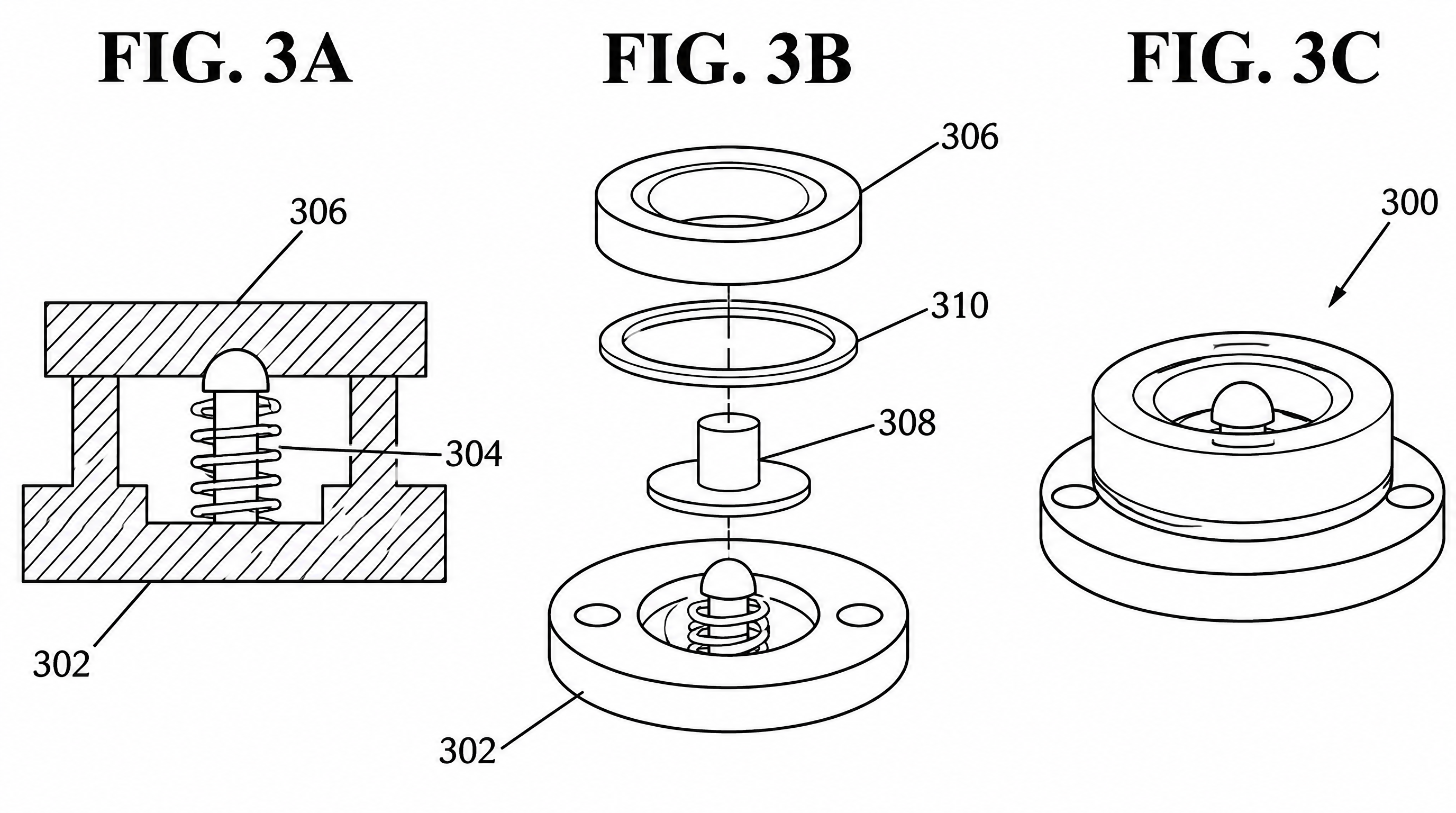
To see how constructive reduction to practice works in real life, let us walk through a fictional patent idea example: a magnetic quick-release camera and lidar sensor mount (300) designed for industrial inspection drones. The founder has not CNC-machined a single part yet — only sketched the locking geometry in a gridded engineering notebook.
Stage 1 (Day 1): Notebook Sketch to Enabled Provisional Filing
On Day 1, the founder knows the core mechanical insight: a base plate (302) uses a recessed neodymium magnet ring (306) to pull the sensor payload into self-centering contact, automatically depressing a spring-loaded radial latch pin (304) so the operator can mount payloads one-handed in gloves.
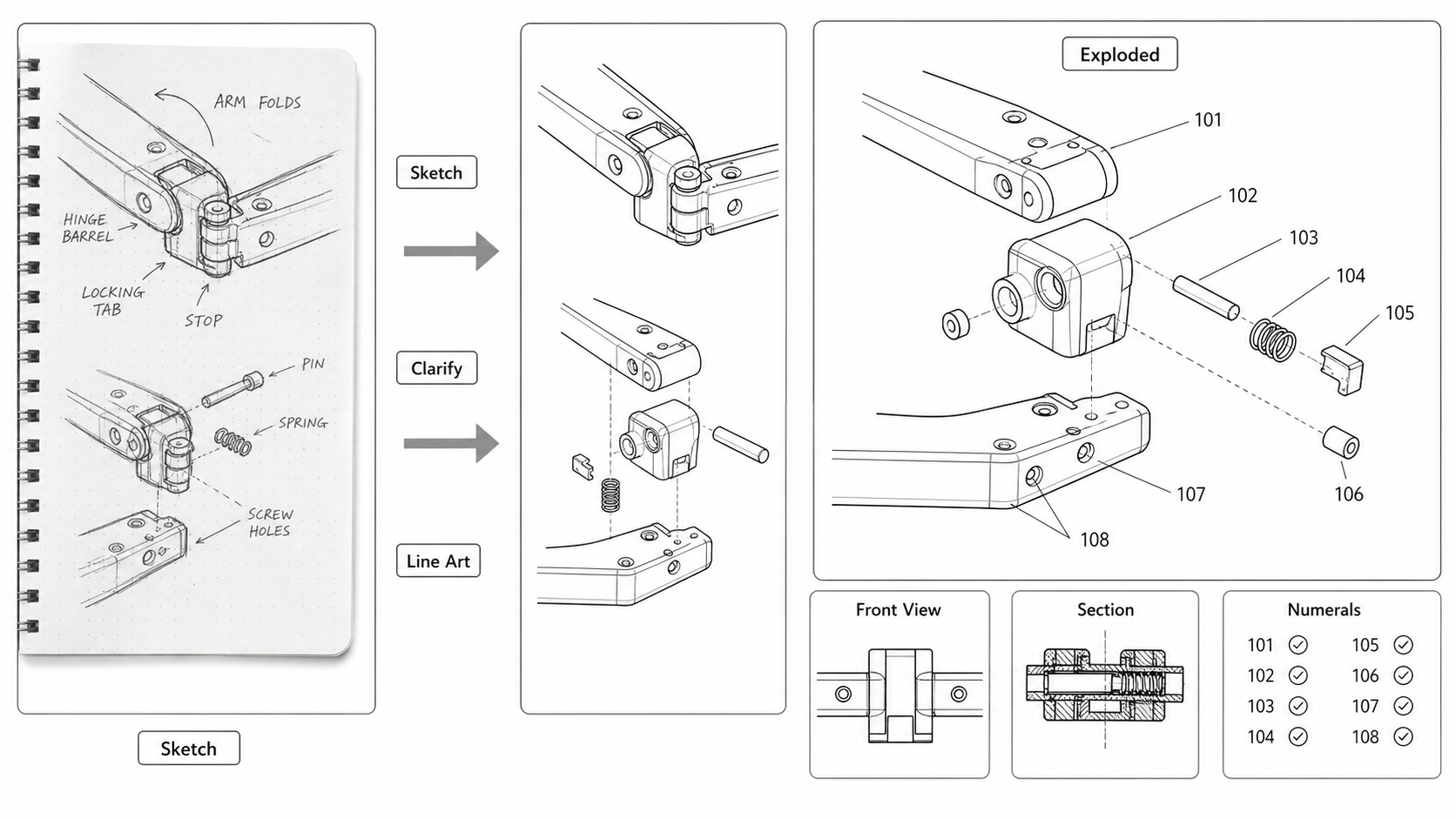
Instead of waiting eight weeks for a machine shop, the founder converts the notebook sketch into clean black-and-white cross-sectional and perspective provisional patent drawings using a sketch-to-patent-drawing workflow (see our annotated provisional patent example guide for how specification text locks onto every numeral). Because FIG. 3A clearly shows how magnet ring 306 aligns with spring latch pin 304, and the text specifies workable spring constants, magnet pull ranges, and release travel, the Day-1 filing satisfies 35 U.S.C. § 112(a) enablement — zero physical parts required.
Stage 2 (Months 2–6): Benchtop Prototyping and Rolling Updates
With a USPTO provisional serial number secured, the founder safely sends .STEP files to a rapid-CNC vendor and tests 3D-printed prototypes on a shaker table. Vibration testing reveals a practical issue: high-frequency rotor buzz causes micro-fretting on the flat mating face.
The founder updates the SolidWorks assembly (FIG. 3B), adding a tapered conical alignment boss (308) and a shore-70A elastomer damping ring (310). Because those two structural elements were not in the Day-1 filing — and could become valuable dependent claims — the founder exports hidden-line views via a CAD-to-patent-drawing pipeline and files a brief second provisional application covering the damped conical interface.
Stage 3 (Months 6–9): Using Patent Drawings That Impress Investors in a Patent Pitch Deck
Midway through hardware validation, the startup raises a pre-seed round. Investors rarely read 25 pages of patent prose during a 15-minute partner meeting, and blurry smartphone photos of 3D-printed PLA prototypes covered in hot glue often make early hardware look riskier than it is.
Dropping crisp, numbered patent line art (FIG. 3B and FIG. 3C) onto the IP slide of a patent pitch deck accomplishes three things at once:
- Instant technical credibility: Clean patent drawings that impress investors make an early-stage mechanism look engineered, structured, and defensible — much like the classic industrial figures in our patent drawing examples gallery.
- Safe post-filing storytelling: Because the underlying provisional applications are already on file, marking the slide Patent Pending (U.S. Provisional Appl. Filed) lets you explain what makes your mechanism defensible without triggering a pre-filing public-disclosure bar.
- Selective disclosure control: Line-art patent figures illustrate structural relationships (
302,304,308,310) without exposing proprietary CNC toolpaths, vendor part numbers, or unfiled firmware calibration tables.
Stage 4 (Month 12): Consolidating into Formal Non-Provisional & PCT Drawings
Before the 12-month anniversary of the Day-1 provisional, patent counsel merges both provisional disclosures into a single non-provisional U.S. utility application (and, if global markets matter, a PCT international application), claiming priority to both filing dates. At this stage, every sheet must pass strict patent drawing requirements under 37 CFR § 1.84: uniform black ink lines on pure white, minimum 0.32 cm numeral height, proper 45-degree section hatching, and exact margin boundaries — whether finalized in-house or reviewed alongside a specialist patent illustrator.
How to Generate Filing-Ready Figures Before Your First Physical Build
Whether you are locking a Day-1 priority date from a whiteboard sketch or refreshing your figures after a CAD revision, keep one consistent reference-numeral table from start to finish:
- Start from whatever artifact you have today: Upload a pencil concept sketch via sketch to patent drawing or export clean orthographic and exploded views through CAD to patent drawing (also see our sketch-to-patent-figure tutorial).
- Cover every claimed relationship in at least two views: Pair an assembled perspective view (
FIG. 1) with an exploded assembly or cross-sectional view (FIG. 2) so internal pins, seals, PCBs, and springs are never hidden behind an outer housing shell. - Keep reference numerals consistent across provisional and non-provisional drafts: Assign
102,104,106once on Day 1 and preserve those exact numbers as you add Month-6 refinements (108,110).
Turn Your Hardware Concept into Patent-Ready Line Art Today
You do not need to wait for machine shops, injection molds, or PCBA lead times to protect an invention that already works on paper. Upload a rough sketch, CAD screenshot, or written technical description in the PatentFig AI generator to produce clean, numbered black-and-white patent figures ready for your provisional filing and your next investor deck.
Sources: 35 U.S.C. § 112(a) — Enablement & Written Description (MPEP 2164) · MPEP 2138.05 — Constructive vs. Actual Reduction to Practice · 35 U.S.C. § 102 — Novelty & Prior Art Grace Period · 37 CFR § 1.84 — Standards for Patent Drawings
Frequently Asked Questions
Do you need a prototype to get a patent in the United States?
No. Under 35 U.S.C. 112(a), the USPTO accepts constructive reduction to practice: if your written specification and patent drawings describe the invention clearly enough that a person of ordinary skill in the art can make and use it without undue experimentation, no physical patent prototype is required.
Should hardware startups build a prototype or patent first?
If the core mechanical or electrical mechanism is clear on paper and you plan to pitch investors without NDAs, launch a crowdfunding campaign, or send CAD files to overseas suppliers, file a provisional patent first to lock your priority date. If fundamental physics or manufacturability is still uncertain, run confidential benchtop tests first, then file before any external disclosure.
What happens if I demo my prototype publicly before filing a patent?
Publicly demonstrating, selling, or posting your prototype online destroys novelty at the EPO, which has no general grace period, and CNIPA allows only a narrow six-month exception (for example, certain government-recognized exhibitions). Japan (JPO) and Korea (KIPO) offer a 12-month grace period for your own disclosure, but only with a formal claim at filing. The United States offers a one-year inventor grace period under 35 U.S.C. 102(b)(1), yet relying on grace periods still forfeits European rights and leaves gaps if competitors file variations.
What if my hardware design changes while prototyping after I file a provisional?
A provisional application only protects the technical details actually disclosed on its filing date. Hardware teams solve this with an iterative provisional loop: file an initial provisional on Day 1, file brief follow-on provisionals when major structural changes occur on the benchtop, and consolidate everything into one non-provisional utility and PCT filing within 12 months.
Can I put provisional patent drawings in an investor pitch deck?
Yes, once your provisional application is filed and assigned a USPTO application number. Clean, numbered line-art figures signal Patent Pending discipline in a patent pitch deck while letting you withhold unfiled manufacturing tolerances or supplier trade secrets.
Author

Categories
More Posts
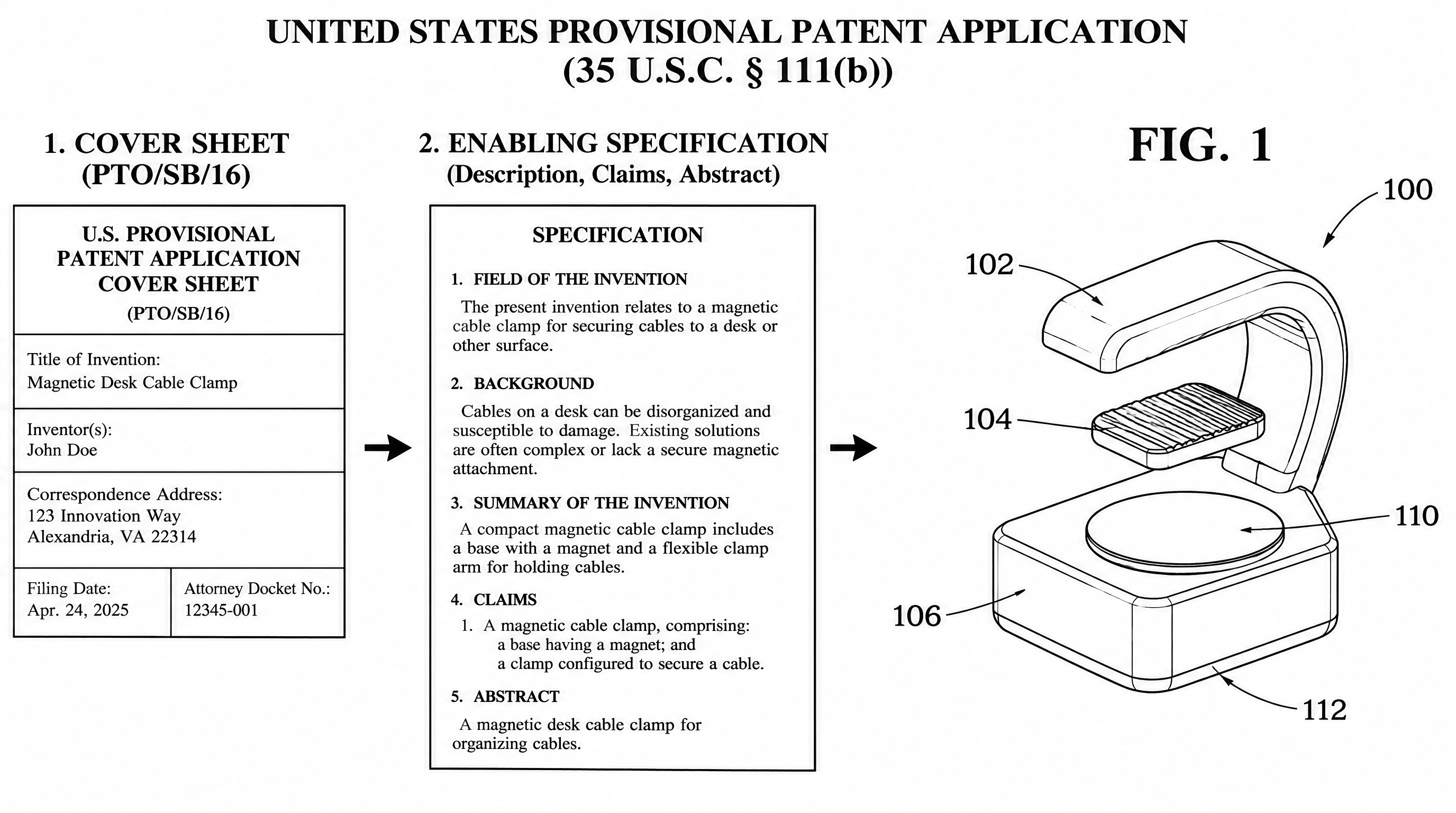
Provisional Patent Example: Annotated Sample, Cover Page & Drawings (2026)
Provisional patent example with annotated cover page (PTO/SB/16), enabling specification, sample claim, and 3-figure provisional patent drawings under 35 U.S.C. 111(b).
Sketch to Patent Figure: Turning Inventor Notes Into Filing-Ready Drawings
Convert hand-drawn inventor sketches into patent figures: scanning tips, AI line-art extraction, when to redraw, and what gets lost between a napkin and a USPTO submission.
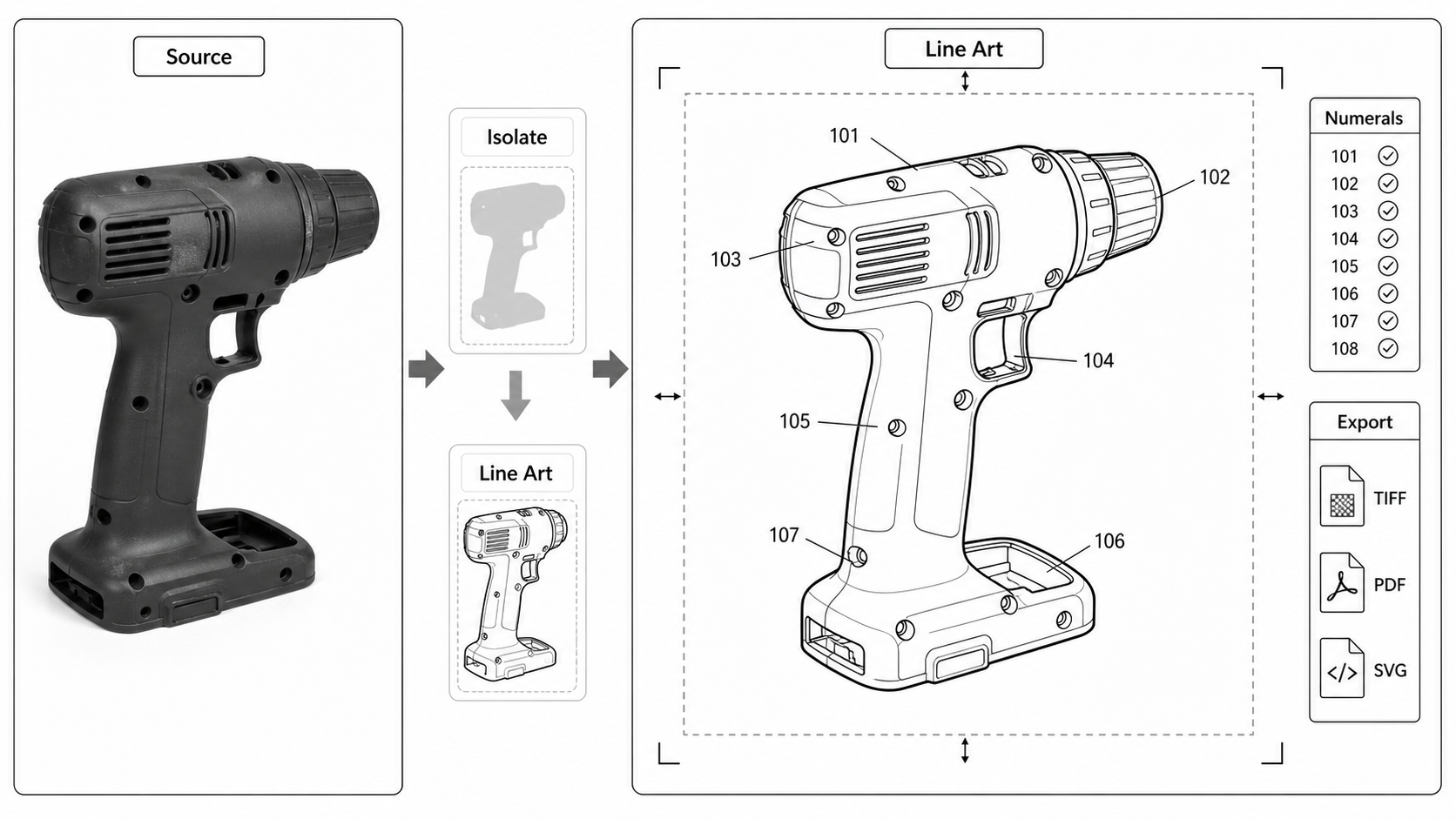
Photo to Patent Drawing AI: A Practical Workflow
Turn product photos into patent-style line art: photo prep, AI line extraction, what AI invents and what it loses, and the cleanup steps before filing.
Newsletter
Join the community
Subscribe to our newsletter for the latest news and updates