Best AI Patent Drafting Tools, and Where Figures Fit
AI now helps with patent drafting, prior-art search, and analysis — but most drafting tools stop short of producing filing-ready figures. Here is how the categories compare and where patent drawings fit.
- Drafting vs. figures
- Search & analysis
- Where drawings fit
- Office-aware figures
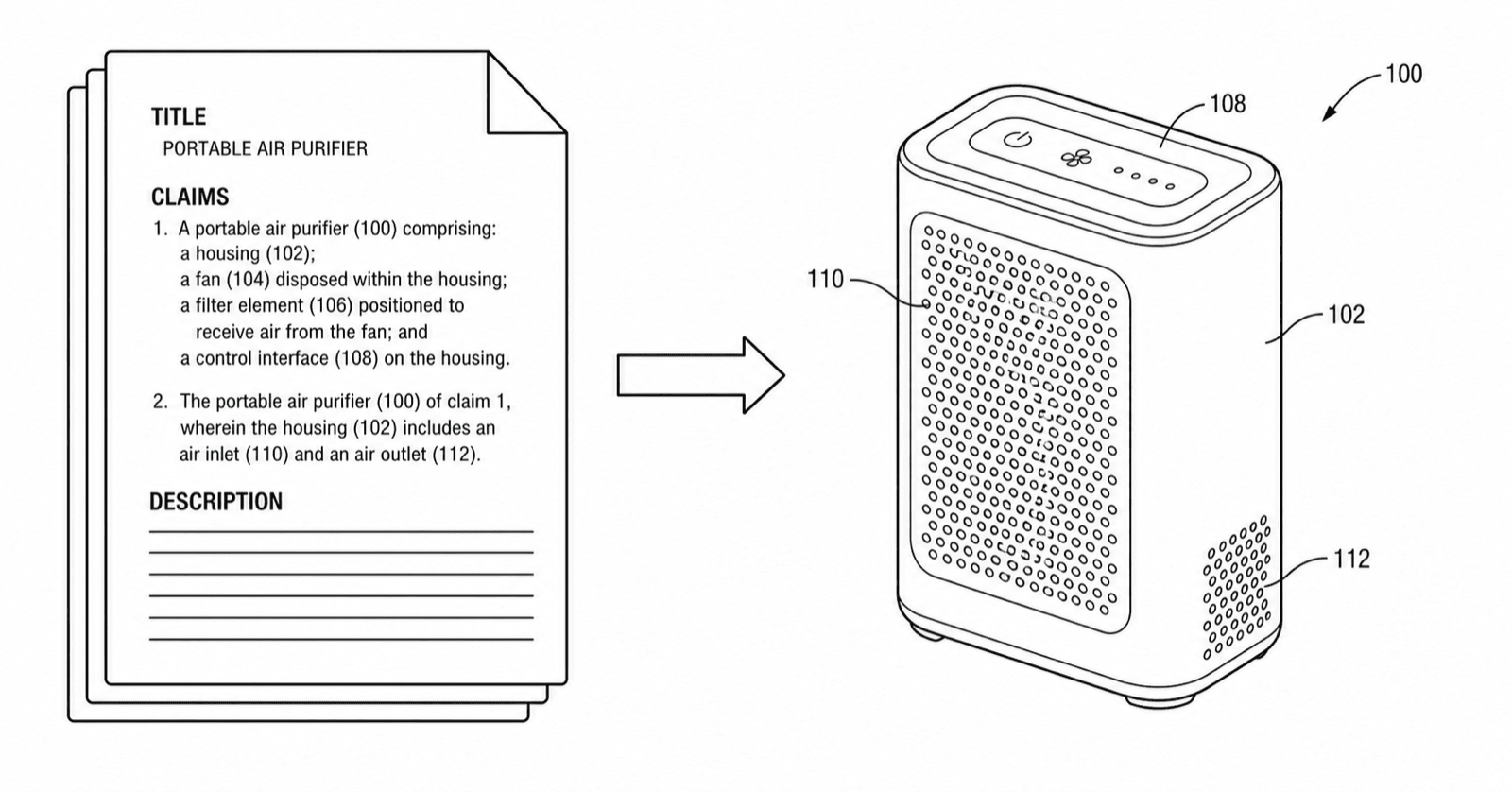
How to combine AI patent tools
A typical AI-assisted patent workflow uses more than one tool.
1
Search prior art
Use an AI patent search tool to assess novelty before drafting.
2
Draft the specification
Use an AI drafting tool to draft claims and the written description.
3
Generate the figures
Use PatentFig AI to produce the compliant drawings the drafting tool does not.
4
Check and file
Validate figures against your office, then assemble and file with attorney review.
Categories of AI patent tools
What each category does — and does not — cover.
Drafting assistants
Claims and specification text.
Prior-art search
Novelty and freedom-to-operate.
Portfolio analysis
Landscape and competitor mapping.
Figure generation
The drawings — PatentFig AI.
Compliance checking
Office-rule validation before filing.
Export & formats
Vector and DPI outputs for submission.
How to evaluate each tool category
Evaluate the job each category completes, the evidence it exposes, and where attorney review stays mandatory.
Drafting assistant
Check claim-to-description traceability, version control, citations, and export into the firm’s document workflow.
Prior-art search
Check source coverage, reproducible search logic, family deduplication, and human review of relevance.
Portfolio analysis
Check data freshness, ownership normalization, explainable scoring, and export for counsel or business review.
Figure generation
Check supported inputs and figure types, numeral consistency, targeted edits, and whether real filing outputs are shown.
Compliance checking
Check the offices covered, the exact rules tested, issue explanations, and whether a corrected output can be exported.
Security and procurement
Confirm training policy, retention, deletion, contractual confidentiality, access controls, and audit requirements.
Drafting tools vs. figure tools
Why a drafting tool and a figure tool are complementary, not competing.
AI drafting / search tools
PatentFig AI (figures)
Primary output
Claims, specification, search reports
Filing-ready patent drawings
Drawings
Usually none
Utility, design, electrical, flowcharts
Reference numerals
Text references only
Numerals consistent across views
Office compliance
Text formatting
USPTO/EPO/CNIPA/JPO/KIPO/PCT figures
Export
DOCX / text
PNG, SVG, DXF, vector PDF
Best used for
Writing the application
Illustrating the application
AI patent tools
AI patent tools FAQ
Add compliant figures to your AI patent workflow
Whatever you draft with, generate and validate the drawings in PatentFig AI.
Related tools and guides
Guide: build an AI-assisted patent workflow
Connect research, drafting, figures, checking, and attorney review by workflow stage.
Patent drawing software
The full PatentFig workspace for filing-ready figure sets.
Patent drawing examples
Browse sample patent figures across every category.
Figure checker
Validate figures against office rules before filing.
Detailed guide
Read the related workflow article on the blog.
Patent drawing generator
Generate a patent drawing from a text description.
Patent illustrator
AI patent illustration workflow for first drafts.