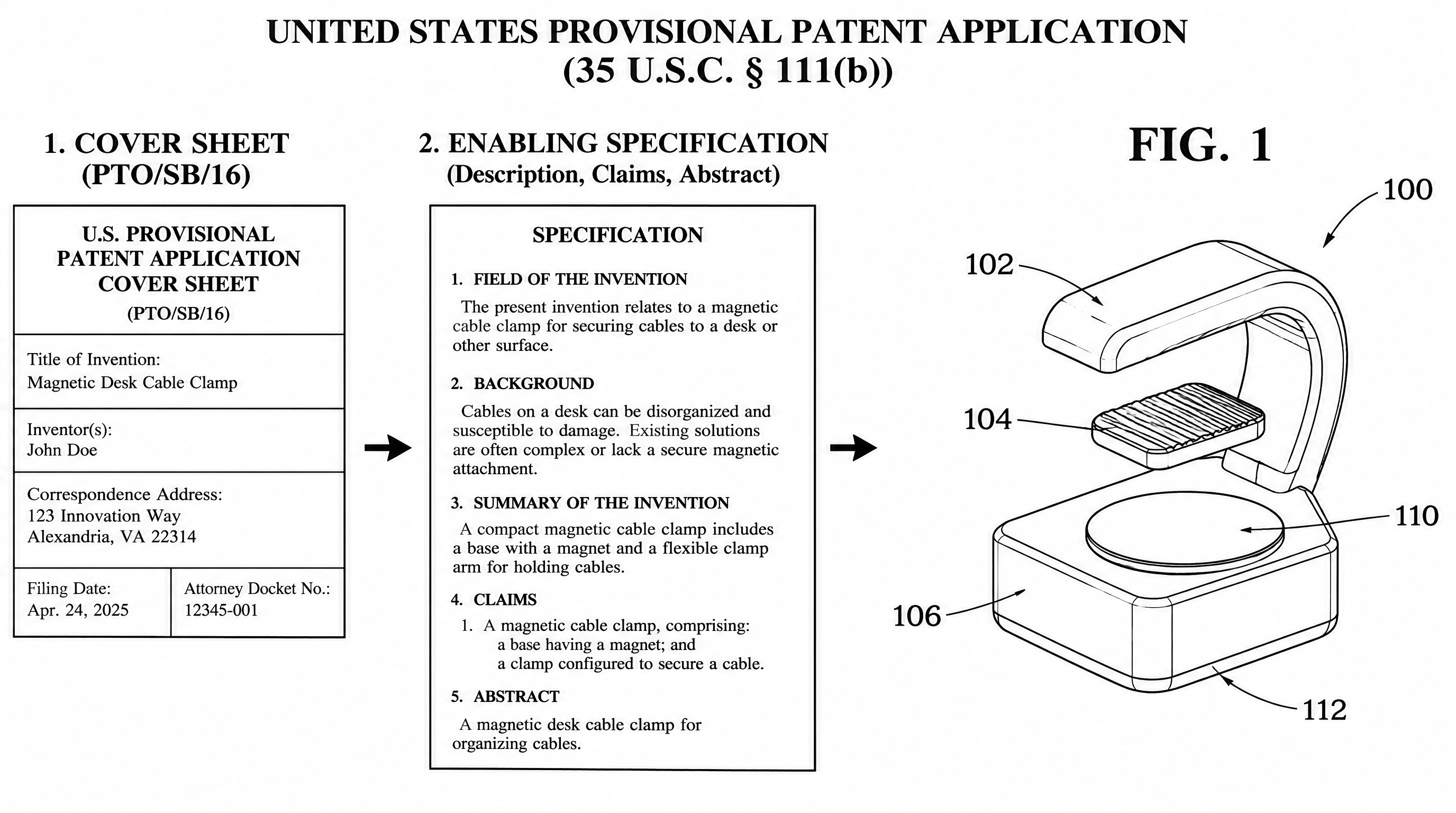
Provisional Patent Example: Annotated Sample, Cover Page & Drawings (2026)
Provisional patent example with annotated cover page (PTO/SB/16), enabling specification, sample claim, and 3-figure provisional patent drawings under 35 U.S.C. 111(b).
TL;DR: A provisional patent example is never published on its own unless a later non-provisional application claims priority to it — which is why most first-time founders have never seen one end to end. A strong USPTO provisional patent application under 35 U.S.C. 111(b) combines four working parts: a cover page (Form PTO/SB/16 or Patent Center ADS), an enabling written specification tied to consistent reference numerals, a multi-view drawing set that reveals every structural and functional feature, and one optional demonstration claim to anchor terminology before your 12-month conversion deadline.
Searching for a provisional patent example on Google Patents usually turns up granted B2 patents and A1 non-provisional publications, leaving inventors guessing how formal their initial filing needs to be. This practical provisional patent guide walks through every required component and presents an original, fully annotated fictional hardware filing — a Magnetic Quick-Release Desk Cable Clamp (100) — complete with cover sheet fields, specification text, reference numerals, sample claim language, and patent-style line drawings.
Need clean, numbered line-art figures for your provisional filing without waiting weeks on a drafter? Generate provisional-ready patent figures in PatentFig AI.
Provisional Patent vs. "Preliminary Patent": How the 12-Month Priority Window Works
Founders and product teams frequently ask how to file a "preliminary patent." Under US patent law, there is no granted document called a preliminary patent. The legal instrument behind that phrase is a Provisional Application for Patent governed by 35 U.S.C. 111(b).
Understanding what that filing does — and what it refuses to do — prevents expensive filing mistakes:
- Immediate "Patent Pending" status for 12 months: The moment USPTO Patent Center issues your
63/series application number and filing receipt, you may mark prototypes, pitch decks, packaging, and landing pages "Patent Pending." - Zero substantive examination: A provisional application is never assigned to an examiner, never searched for prior art, and never matures into an enforceable patent by itself. It automatically expires exactly 12 months after its filing date.
- Priority anchor under
35 U.S.C. 119(e): To turn that filing date into a real patent, you must file a corresponding non-provisional utility application (or an international PCT application) within 12 months and specifically claim the benefit of the provisional filing date. - Utility and plant inventions only — never design patents: Under
35 U.S.C. 172, design patents cannot claim priority to a provisional application. If you want to protect ornamental product appearance rather than functional structure, skip the provisional route and prepare formal views directly with design patent drawing software. - Your priority date is only as strong as your day-one disclosure: Under
35 U.S.C. 112(a), your provisional application shields later non-provisional claims against intervening prior art only to the extent the provisional specification and drawings already describe and enable every claimed element.
Parts of a Provisional Patent Application
Unlike a non-provisional utility patent, a provisional application does not require formal claims, an abstract, an inventor oath/declaration, or an Information Disclosure Statement (IDS). Still, disciplined provisional patent drafting treats the disclosure with non-provisional rigor so you do not leave structural gaps behind.
Here are all the parts of a provisional patent filing package at the USPTO:
| Component | Legal / Form Reference | Required? | Practical Role in Your Filing |
|---|---|---|---|
| Provisional Cover Page | Form PTO/SB/16 or Patent Center electronic ADS (37 CFR 1.51(c)(1)) | Required | Identifies the filing as a provisional application, lists every true inventor, sets correspondence address, and declares entity size. |
| Written Specification | 35 U.S.C. 112(a) (Written Description & Enablement) | Required | Teaches a skilled engineer how to make and use the invention across its main embodiment and reasonable structural alternatives. |
| Drawing Sheets | 35 U.S.C. 113 & 37 CFR 1.84 conventions | Required when needed to understand the invention | Depicts assembled geometry, internal cross-sections, and component relationships tied to reference numerals (100, 102, 104). |
| USPTO Filing Fee | 37 CFR 1.16(d) (up to 100 sheets) | Required | $65 Micro Entity · $130 Small Entity · $325 Undiscounted (Large Entity) under current USPTO fee schedules (extra-sheet surcharge applies past 100 pages). |
| Micro Entity Certification | Form PTO/SB/15A (Gross Income) or 15B (Institution) | Only if claiming Micro Entity | Certifies eligibility for the 80% fee reduction before paying the micro-entity rate. |
| Demonstration Claim Set | Optional (1–3 broad claims recommended) | Optional | Forces the drafter to name every essential structural part and confirm each element appears in both text and drawings. |
Do Provisional Patent Applications Require Drawings?
One of the most searched questions in early-stage IP is "do provisional patent applications require drawings?" Statute 35 U.S.C. 113 answers directly: the applicant shall furnish a drawing where necessary for the understanding of the subject matter sought to be patented.
Except for pure chemical formulations or text-only synthesis recipes, drawings for provisional patent application filings are indispensable. Courts routinely invalidate priority claims when a founder describes a mechanism vaguely in prose during month zero and relies on newly drawn geometry added in month twelve. Preparing clean provisional patent drawings up front locks in visual support for every hinge, channel, sensor, or method step from day one.
Complete Annotated Provisional Patent Example
To show how all pieces lock together without reproducing anyone's confidential IP, below is a complete annotated provisional patent example for an original fictional hardware invention: a Magnetic Quick-Release Desk Cable Clamp (100).
Notice how every part number introduced in the specification (100, 102, 104, 106, 108, 110, 112) corresponds one-to-one with the drawing callouts and sample claim.
1. Provisional Patent Application Cover Page (Form PTO/SB/16 Excerpt)
Whether you upload PDF Form PTO/SB/16 or fill out the web-based Application Data Sheet in USPTO Patent Center, your provisional patent application cover page captures these core bibliographic fields:
PROVISIONAL APPLICATION FOR PATENT COVER SHEET (37 CFR 1.51(c)(1))
[Annotated Fictional Sample — Form PTO/SB/16 Equivalent]

INVENTOR(S):
  Given Name: Elena            Family Name: Vance
  Residence:  Austin, TX, US

TITLE OF THE INVENTION (500 characters max):
  MAGNETIC QUICK-RELEASE DESK CABLE CLAMP WITH MULTI-SLOT ELASTOMER RETENTION CHANNEL

CORRESPONDENCE ADDRESS:
  Customer Number or Direct Address: Elena Vance, 410 Congress Ave, Suite 900, Austin, TX 78701
  Email: ip-docketing@example-hardware.io

ENCLOSED APPLICATION PARTS:
  [X] Specification — Number of Pages: 7
  [X] Drawing(s)    — Number of Sheets: 2 (FIG. 1 through FIG. 3)
  [ ] Application Data Sheet (37 CFR 1.76) [Used instead of SB/16 when filing via Patent Center]

ENTITY STATUS:
  [X] Small Entity (37 CFR 1.27) — Filing Fee Enclosed: $130.00

U.S. GOVERNMENT PROPERTY / AGENCY INTEREST:
  [X] No — Invention was NOT made by an agency of the U.S. Government nor under a Government contract.

SIGNATURE: /Elena Vance/                 DATE: 2026-11-25
TYPED OR PRINTED NAME: Elena Vance       REGISTRATION NO. (if attorney/agent): N/A (Pro Se)
Drafting note: List every human contributor who conceived how the invention works. Naming a company as the inventor or omitting a co-inventor is a common cover-sheet error; company ownership is recorded separately via an assignment.
2. Title, Field, and Background Excerpt
Keep the title specific rather than marketing-driven, and keep the Background brief — never disparage your own approach or admit what is "obvious" in prior art:
TITLE OF THE INVENTION
MAGNETIC QUICK-RELEASE DESK CABLE CLAMP WITH MULTI-SLOT ELASTOMER RETENTION CHANNEL

TECHNICAL FIELD
[0001] The present disclosure relates generally to desktop cable management hardware, and more particularly to an edge-mounted mechanical clamp having a spring-hinged magnetic upper jaw for one-handed cable insertion and release.

BACKGROUND
[0002] Rigid desktop cable clips typically rely on peel-and-stick adhesive pads or narrow snap-fit plastic slots. Adhesive pads leave residue and detach under lateral cord tension, whereas tight snap-fit slots fray braided charging cables when cords are repeatedly inserted and removed. Existing C-clamp organizers require two-handed unscrewing whenever a user swaps a laptop power cable.
3. Brief Description of the Drawings & 3-Figure Provisional Drawing Set
Even in a provisional filing, include a clean Brief Description of the Drawings followed by numbered black-and-white views:
BRIEF DESCRIPTION OF THE DRAWINGS
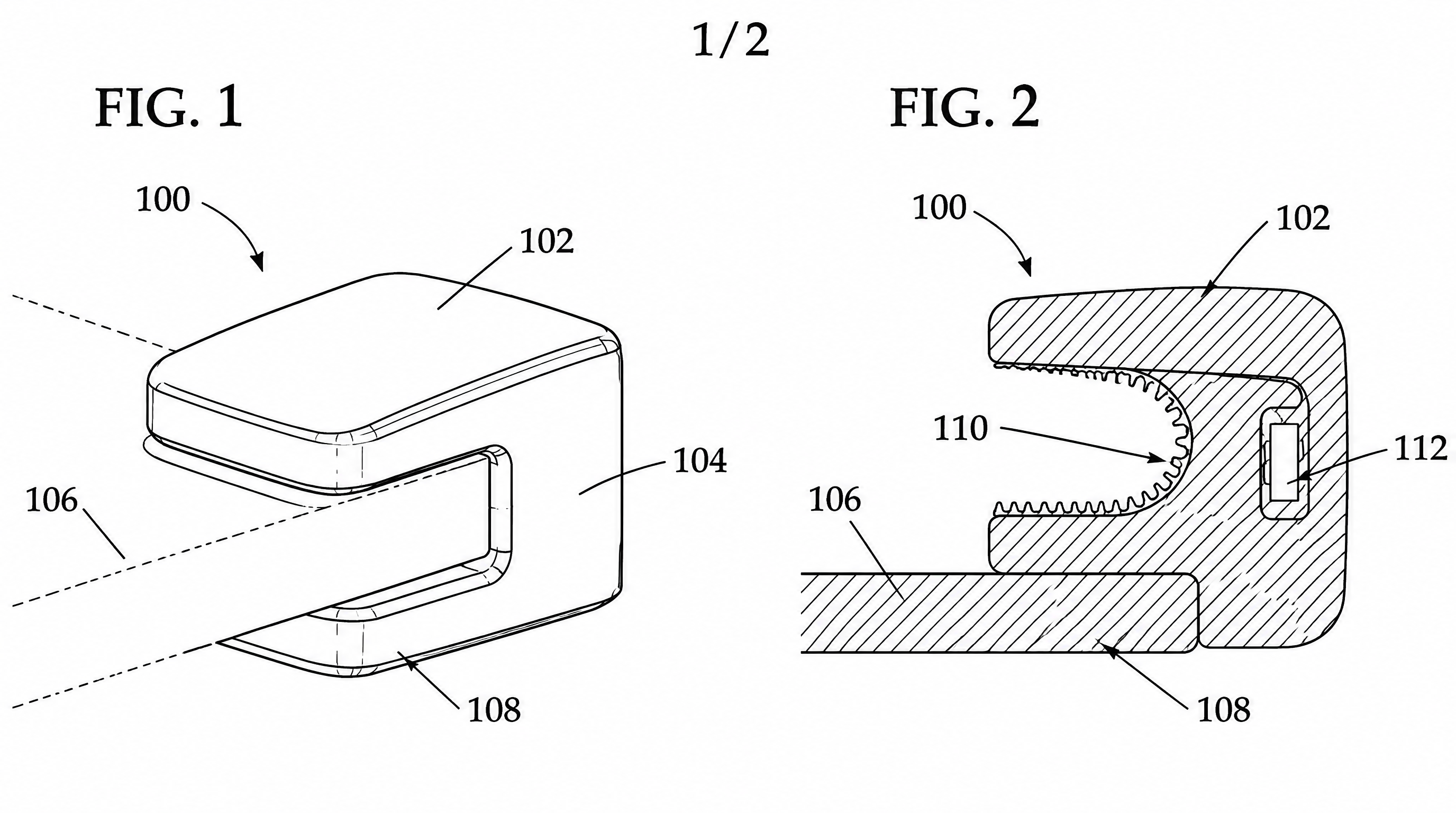
[0003] FIG. 1 is a front-right isometric view of a magnetic quick-release desk cable clamp 100 in a closed clamping position mounted to a desk edge.
[0004] FIG. 2 is a cross-sectional side elevation view of the magnetic quick-release desk cable clamp 100 in the closed clamping position, illustrating the elastomer channel 110 and recessed magnetic locking detent 112.
[0005] FIG. 3 is an exploded isometric view of the magnetic quick-release desk cable clamp 100 showing the upper jaw 102, torsion spring hinge 104, removable elastomer channel 110, magnetic locking detent 112, lower C-clamp frame 106, and adjustment thumbscrew 108.
Here is Sheet 1/2 (FIG. 1 isometric assembled view and FIG. 2 internal cross-sectional elevation view) from our annotated provisional drawing set:
And here is Sheet 2/2 (FIG. 3 exploded assembly view), exposing every internal mechanical part so a non-provisional attorney can claim sub-combinations twelve months later without hitting new-matter rejections:
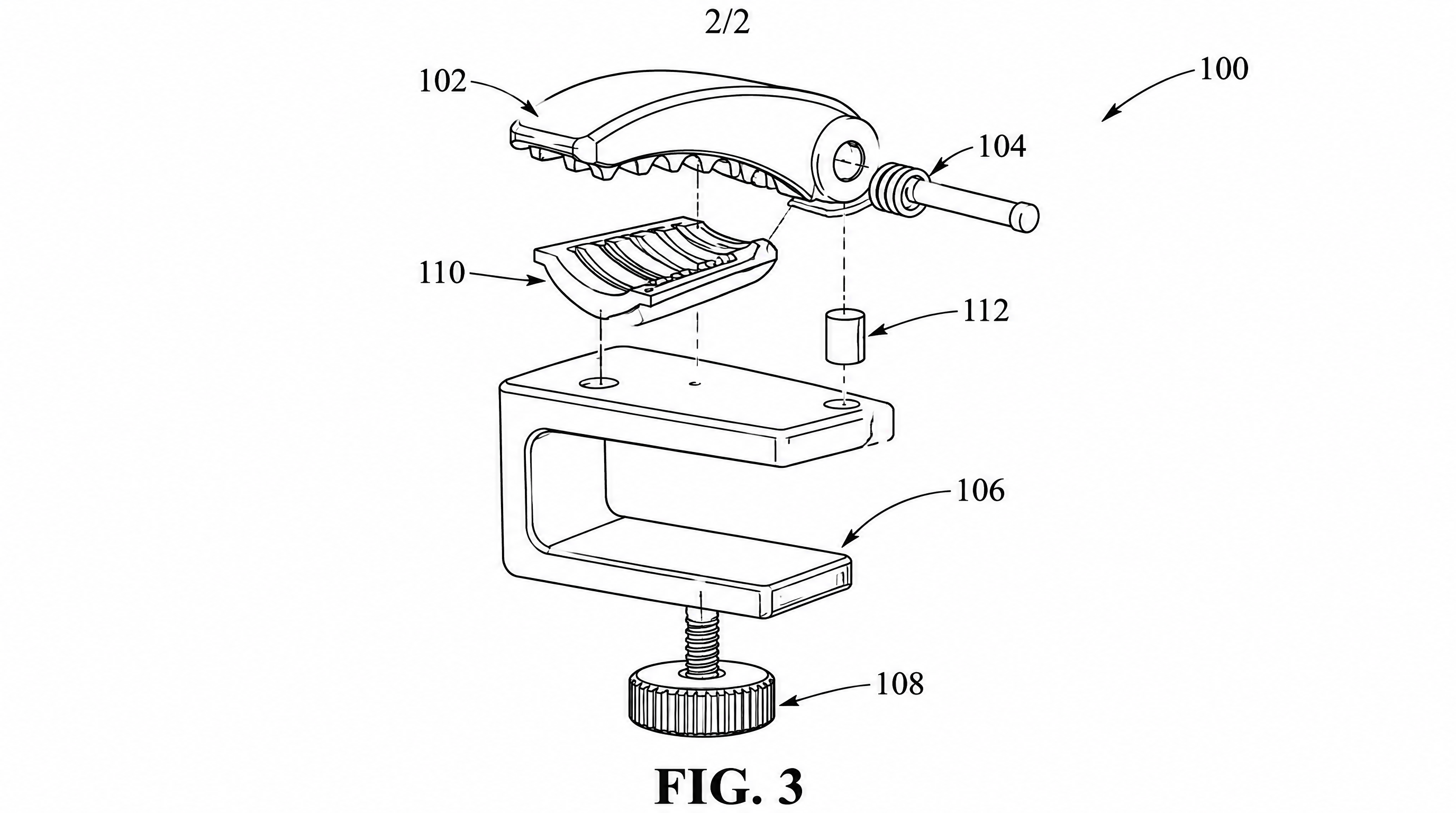
Notice why three views carry so much legal weight: FIG. 1 establishes external assembly context, FIG. 2 proves how the internal cable ribs and magnetic detent interact when closed, and FIG. 3 documents how each component mounts and disassembles. You can browse dozens more multi-view configurations across mechanical, electrical, and software domains in the patent drawing examples gallery.
4. Detailed Description Tied to Reference Numerals (Plus Alternatives!)
A strong provisional specification walks through each numbered element systematically and discloses fallback materials and geometries so competitors cannot design around a narrow prototype:
DETAILED DESCRIPTION OF EXAMPLE EMBODIMENTS
[0006] Referring to FIG. 1 through FIG. 3, a magnetic quick-release desk cable clamp 100 includes a rigid lower C-clamp frame 106 configured to straddle a horizontal work surface edge having a thickness between 10 mm and 55 mm. An adjustment thumbscrew 108 threads vertically through a tapped lower leg of the C-clamp frame 106 to secure the assembly without tools. In alternative embodiments, the adjustment thumbscrew 108 may be replaced by a cam-lever over-center latch or a spring-loaded plunger.

[0007] A pivoting upper jaw 102 is coupled to a rear spine of the lower C-clamp frame 106 via a torsion spring hinge 104. The torsion spring hinge 104 biases the pivoting upper jaw 102 toward an open release orientation at an angle of approximately 45 degrees to 75 degrees relative to an upper deck of the lower C-clamp frame 106 when unlatched, permitting single-handed drop-in placement of charging and display cables.

[0008] Seated within a dovetail recess on the upper deck of the lower C-clamp frame 106 is a removable multi-slot elastomer channel 110 formed of Shore 40A–70A silicone or thermoplastic elastomer (TPE). Parallel arcuate ribs inside the elastomer channel 110 deform elastically against cables ranging from 2.5 mm to 8.0 mm in outer diameter so thin cords are gripped without crushing thicker braided jackets.

[0009] Near a front lip opposite the torsion spring hinge 104, a recessed magnetic locking detent 112 pairs a cylindrical neodymium magnet press-fit into the pivoting upper jaw 102 with a ferromagnetic striker or opposing-polarity magnet seated in the lower C-clamp frame 106. When a user presses the pivoting upper jaw 102 downward overcoming the bias of the torsion spring hinge 104, the magnetic locking detent 112 snaps shut with a holding force between 8 N and 25 N. Pressing a front finger tab lifts the pivoting upper jaw 102 past the magnetic breakaway threshold so the torsion spring hinge 104 pops the jaw open automatically.
5. Optional Demonstration Claim
Although claims are not mandatory under 35 U.S.C. 111(b), ending your provisional patent drafting document with at least one broad apparatus claim verifies that your prose and drawings form a complete, self-consistent teaching:
EXAMPLE CLAIM (FOR DISCLOSURE COMPLETENESS)
1. A desk-mounted cable retention apparatus comprising:
   a lower C-clamp frame (106) having an upper deck and a lower clamping leg carrying an adjustment fastener (108);
   a multi-slot elastomer channel (110) supported on the upper deck of the lower C-clamp frame (106);
   a pivoting upper jaw (102) rotatably coupled to the lower C-clamp frame (106) by a spring hinge (104) that biases the pivoting upper jaw (102) away from the multi-slot elastomer channel (110) toward an open position; and
   a magnetic locking detent (112) positioned distal to the spring hinge (104) and configured to releasably retain the pivoting upper jaw (102) in a closed clamping position over the multi-slot elastomer channel (110) against a biasing force of the spring hinge (104).
Why Smartphone Photos ("Provisional Patent Photos") and Unlabeled Sketches Trigger 12-Month New-Matter Traps
Many DIY guides tell inventors they can snap three benchtop smartphone pictures — often searched as provisional patent photos — attach a two-page product memo, pay $130, and worry about real patent drawings next year. That shortcut regularly backfires at month twelve:
- Shadows hide internal enablement: A smartphone photo of a closed prototype housing shows exterior plastic but zero evidence of the torsion spring
104, dovetail elastomer seat110, or magnetic detent geometry112. When your patent attorney adds cross-sectional details to the non-provisional utility application 12 months later, those internal features only get the later non-provisional filing date — leaving you exposed to any public launch, trade-show demo, or competitor filing during the intervening year. - Unlabeled sketches break text-to-figure correspondence: Without unambiguous reference numerals (
100,102,104), an examiner or litigation opponent can argue that ambiguous hand-sketched lines fail to show which component couples to which surface. - Expensive redrawing under deadline pressure: Converting informal photos into compliant
37 CFR 1.84line sheets during week 51 of your 12-month window forces rush illustrator fees right when attorney drafting budgets are tightest. Follow the formal standards in our patent drawing requirements guide early, and your provisional sheets carry straight into your non-provisional utility application with minimal edits.
Instead of filing raw benchtop snapshots, run prototype photos, CAD screenshots, or hand sketches through the utility patent drawing generator or dedicated provisional patent drawings workflow to produce crisp black-and-white line figures with consistent part numbering before you file.
Pre-Filing Checklist Before You Upload to USPTO Patent Center
Before submitting your provisional package, run this five-minute audit:
- Inventorship verified: Every person who contributed to the technical conception is named on
Form PTO/SB/16or the electronic ADS. - Numeral consistency checked: Every reference numeral in your Detailed Description (
100–112) appears with a leader line in at least one figure, and no numeral points to two different parts. - Hidden mechanics exposed: At least one cross-sectional (
FIG. 2) or exploded (FIG. 3) view reveals internal springs, latches, fluid paths, PCBs, or software modules. - Design variations documented: Alternative materials, fasteners, sensor types, and dimension ranges are written into the specification so your future claims are not trapped in a single prototype version.
- 12-month calendar reminders set: Docket hard reminders at Month 8 (begin non-provisional and PCT claim drafting) and Month 11 (finalize formal figures and file well ahead of the non-extendable 12-month bar). Note that if you plan foreign filings in jurisdictions without a US-style grace period, file the provisional before any public disclosure, crowdfunding page, or product sale.
Turn Your Prototype or Sketch Into Provisional Patent Figures
Ready to replace benchtop photos and rough whiteboard sketches with crisp, numbered patent line art for your provisional filing? Open the PatentFig AI generator to create perspective, cross-sectional, and exploded figures in minutes.
Sources: 35 U.S.C. §111(b) (Provisional Application) · 35 U.S.C. §119(e) (Benefit of Earlier Provisional Filing Date) · USPTO Form PTO/SB/16 (Provisional Application Cover Sheet) · 37 CFR §1.84 (Standards for Drawings)
Frequently Asked Questions
Where can I see a real provisional patent example?
Unconverted provisional patent applications stay confidential at the USPTO and are never published on their own. You can inspect real provisional filings in USPTO Patent Center only after a later published non-provisional utility application claims priority to the provisional serial number (series code 63/), or use a complete fictional provisional patent example like the annotated hardware filing in this guide.
Is a preliminary patent the same thing as a provisional patent?
Yes in everyday founder conversation, though "preliminary patent" is not an official legal term. What inventors call a preliminary patent is a USPTO Provisional Application for Patent under 35 U.S.C. 111(b) — a 12-month priority filing that grants "Patent Pending" status without substantive examination or enforceable patent rights on its own.
What are the required parts of a provisional patent application?
A complete USPTO provisional filing includes a provisional patent application cover page (Form PTO/SB/16 or an electronic Application Data Sheet in Patent Center), a written specification satisfying 35 U.S.C. 112(a) enablement, any drawings needed to understand the invention under 35 U.S.C. 113, and the filing fee ($65 micro entity, $130 small entity, or $325 undiscounted large entity). Claims and an oath or declaration are optional.
Do provisional patent applications require drawings?
Under 35 U.S.C. 113, drawings are legally required whenever they are necessary to understand the subject matter sought to be patented. Apart from pure chemical compositions or certain process-only inventions, nearly every mechanical, electrical, medical, consumer hardware, and software-architecture provisional application needs clear drawings to lock in an enforceable priority date.
Can I file smartphone photos as provisional patent photos?
While the USPTO accords a provisional filing date even to informal sketches or smartphone photos, relying on provisional patent photos creates a severe 12-month trap. Photos obscure internal geometry, lack reference numerals, and omit cross-sections, meaning newly drawn details added in your non-provisional filing risk losing the provisional priority date as unsupported new matter.
Author

Categories
Form PTO/SB/16 Excerpt)2. Title, Field, and Background Excerpt3. Brief Description of the Drawings & 3-Figure Provisional Drawing Set4. Detailed Description Tied to Reference Numerals (Plus Alternatives!)5. Optional Demonstration ClaimWhy Smartphone Photos ("Provisional Patent Photos") and Unlabeled Sketches Trigger 12-Month New-Matter TrapsPre-Filing Checklist Before You Upload to USPTO Patent CenterTurn Your Prototype or Sketch Into Provisional Patent FiguresMore Posts
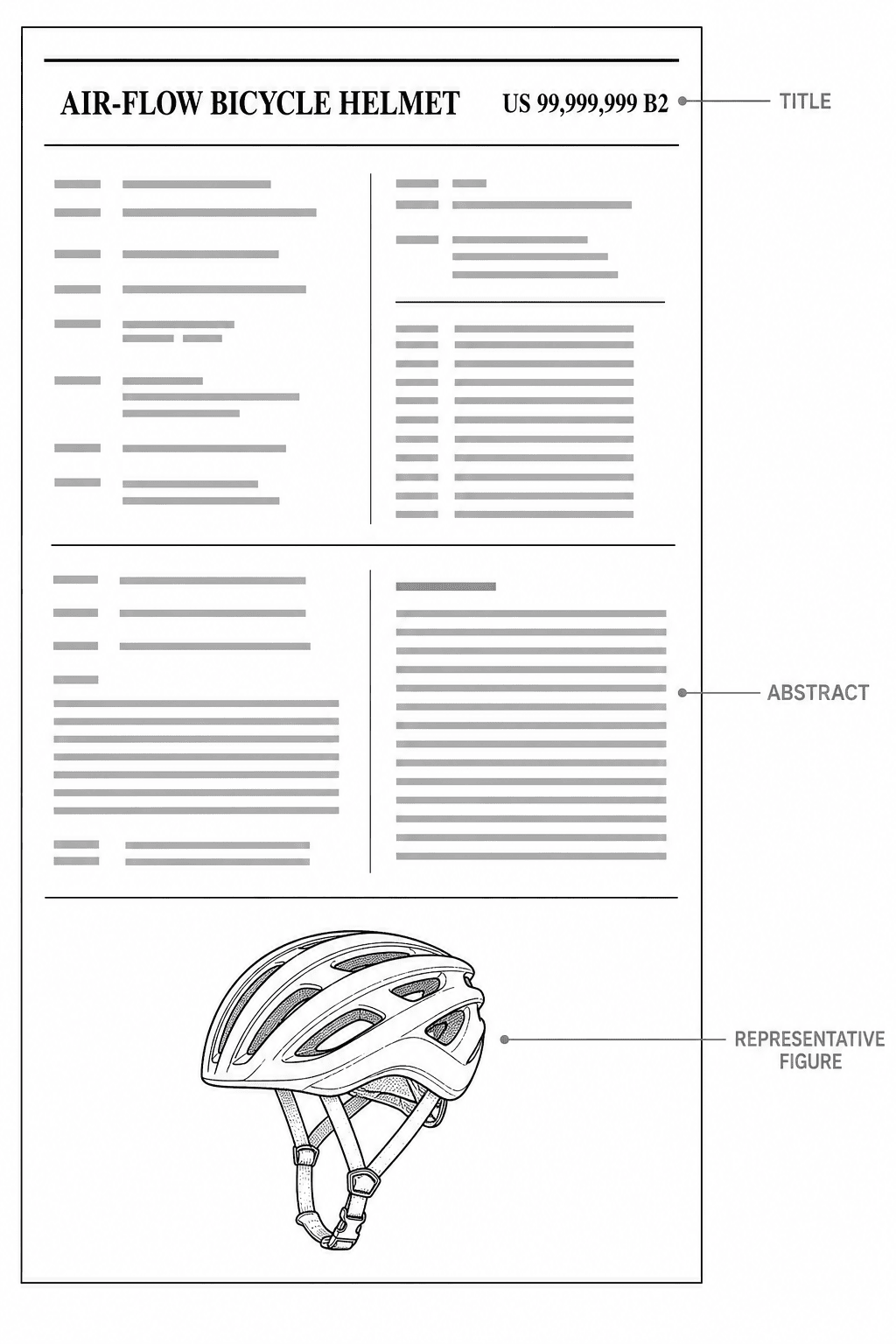
What Does a Patent Look Like? Annotated US Patent Sample & Format (2026)
What does a patent look like? Walk through an annotated US patent sample and patent application format: title page, patent numbers, sample patent abstract, claims, and drawing sheets.
Prototype or Patent First? A Practical Hardware Filing Guide for Founders (2026)
Prototype or patent first? Learn why you do not need a physical patent prototype under 35 U.S.C. 112(a), when to file a provisional first, and how to turn a rough concept into patent drawings that impress investors.
Sketch to Patent Figure: Turning Inventor Notes Into Filing-Ready Drawings
Convert hand-drawn inventor sketches into patent figures: scanning tips, AI line-art extraction, when to redraw, and what gets lost between a napkin and a USPTO submission.
Newsletter
Join the community
Subscribe to our newsletter for the latest news and updates