Biotech Patent Drawings
Biotech figures split between the device and the method — a microfluidic chip you can draw and an assay you can only flowchart. The set works when each claim type gets its figure and the bench photos stay out of the filing.
- Microfluidic plan + detail views
- Assay method flowcharts
- Instrument line art
- FIG. 1A detail conventions
The 30-second answer
- Apparatus claims → a plan (top) view of the chip or cartridge plus enlarged partial views and cross-sections of the functional region, in the FIG. 1, FIG. 1A convention.
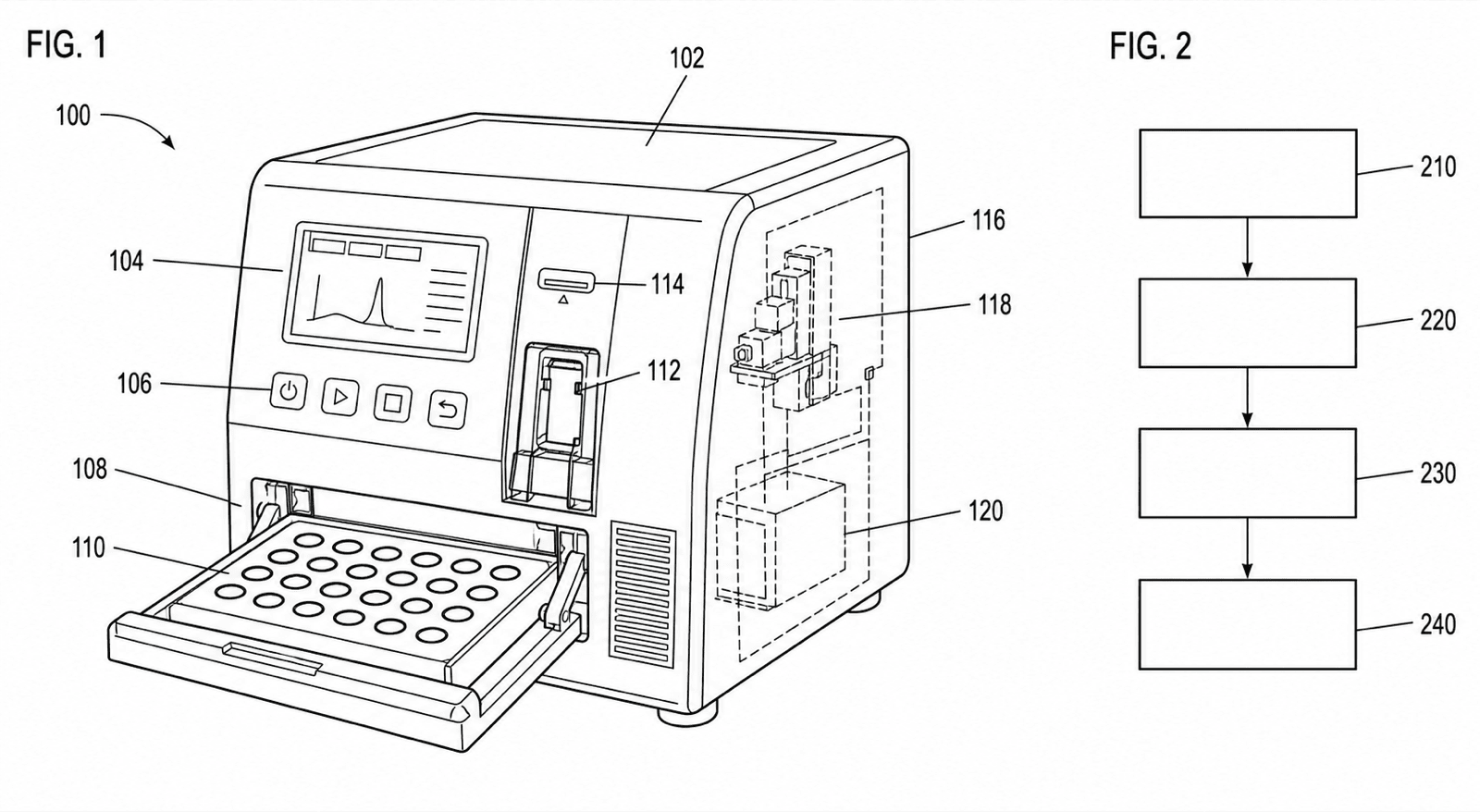
- Assay and method claims → flowcharts with numbered steps that mirror the claim language; instrument claims → perspective line art with numbered modules.
- Keep sequences in the sequence listing and convert bench photos to line art — then run the set through the checker before filing.
Biotech figure examples
Each example is a fictional invention. Open one to pre-fill the generator with the prompt.
Which figures support which claims
Biotech claims split between apparatus and method — match each to its figure type.
1
Device claims → plan views with enlarged details
The chip or cartridge in top view as FIG. 1, with the functional region — mixing junction, reaction chamber — enlarged as FIG. 1A so channel geometry is actually legible.
2
Device claims → cross-sections through the channel
A section through the bonded layers showing channel depth, membrane, and substrate with distinct hatching per material.
3
Assay and method claims → flowcharts
Sample prep, amplification, detection, and analysis as numbered steps that mirror the claim — the standard support for a method-of-detection claim.
4
Instrument claims → perspective line art
The benchtop instrument as clean perspective line work with numbered modules: stage, optics, fluidics, controller — converted from CAD or photo, never filed as a photo.
5
System claims → block diagrams
Instrument, cartridge interface, controller, and analysis software as labeled blocks when the claim spans hardware and processing.
Biotech drawing mistakes that cost office actions
The failure patterns specific to life-science figures.
Microscale features with no enlarged view
A 100 µm channel drawn at full-chip scale is an invisible line. If the claim recites channel geometry, an enlarged partial view (FIG. 1A) is not optional.
Method and device mixed in one figure
Arrows of protocol steps drawn over the chip plan view make both disclosures ambiguous. Give the method its own flowchart and let the device figure stay structural.
Sequence content drawn into figures
Nucleotide and amino acid sequences belong in the formal sequence listing. A sequence rendered as figure art does not satisfy listing rules and clutters the drawing set.
Stained photos filed as figures
Gel images, fluorescence micrographs, and stained sections are grayscale photographs — objection material in a utility filing absent special justification. Redraw the relevant structure as line art.
Outsourcing biotech figures vs. PatentFig AI
Microfluidics and instruments are specialist territory for illustrators — which shows in the rates.
Drawing service
PatentFig AI
Plan + detail + section sets
Each view billed separately
Generated as a consistent set
Assay flowcharts
Often a second vendor or queue
Same workspace as the device figures
Photo-to-line-art conversion
Manual redraw at specialist rates
Upload the photo, get line art
Protocol revisions
$50–$100 per round, days each
Chat edits, same day
Compliance check
Depends on the vendor
Built-in checker for six offices
Typical set cost (6–10 figures)
$600–$2,500
$50/mo · 500 credits · ~50 figures (~$1 each)
PatentFig AI is the better fit when
- Chips and cartridges need plan views, enlarged details, and sections in one consistent set
- Assay methods need flowcharts renumbered as claims are amended
- Inputs are CAD exports, microscope images, or whiteboard protocol sketches
- The family files across USPTO, EPO, CNIPA, JPO, or KIPO
Other channels fit better when
- The disclosure is sequence data or molecular structure formulas — sequences belong in the sequence listing and structures in chemistry software, not figures
- Experimental data plots must be reproduced exactly as recorded
- A litigation-grade set needs a specialist’s certification
Industry guide
Biotech patent drawings FAQ
From bench to figure set
Chips, assays, and instruments — generate compliant biotech figures from what you already have and check them before filing.
Related tools and guides
Medical device patent drawing generator
Cartridges, instruments, and device line art.
Patent flowchart generator
Method and process flowcharts for software patents.
Medical device examples
Sample device figures from the examples gallery.
Figure checker
Validate figures against office rules before filing.
Utility patent drawing generator
Generate utility figures with reference numerals.
Guide: medical device patent figures
Exploded views, cross-sections, and use states.