Consumer Electronics Patent Drawings
Consumer devices get patented twice — once for how they look and once for how they work. The two filings need different drawing sets with different rules, and mixing them is the most expensive mistake in the category.
- Consistent design view sets
- Solid/broken line discipline
- Exploded structural views
- Line-pattern textures
The 30-second answer
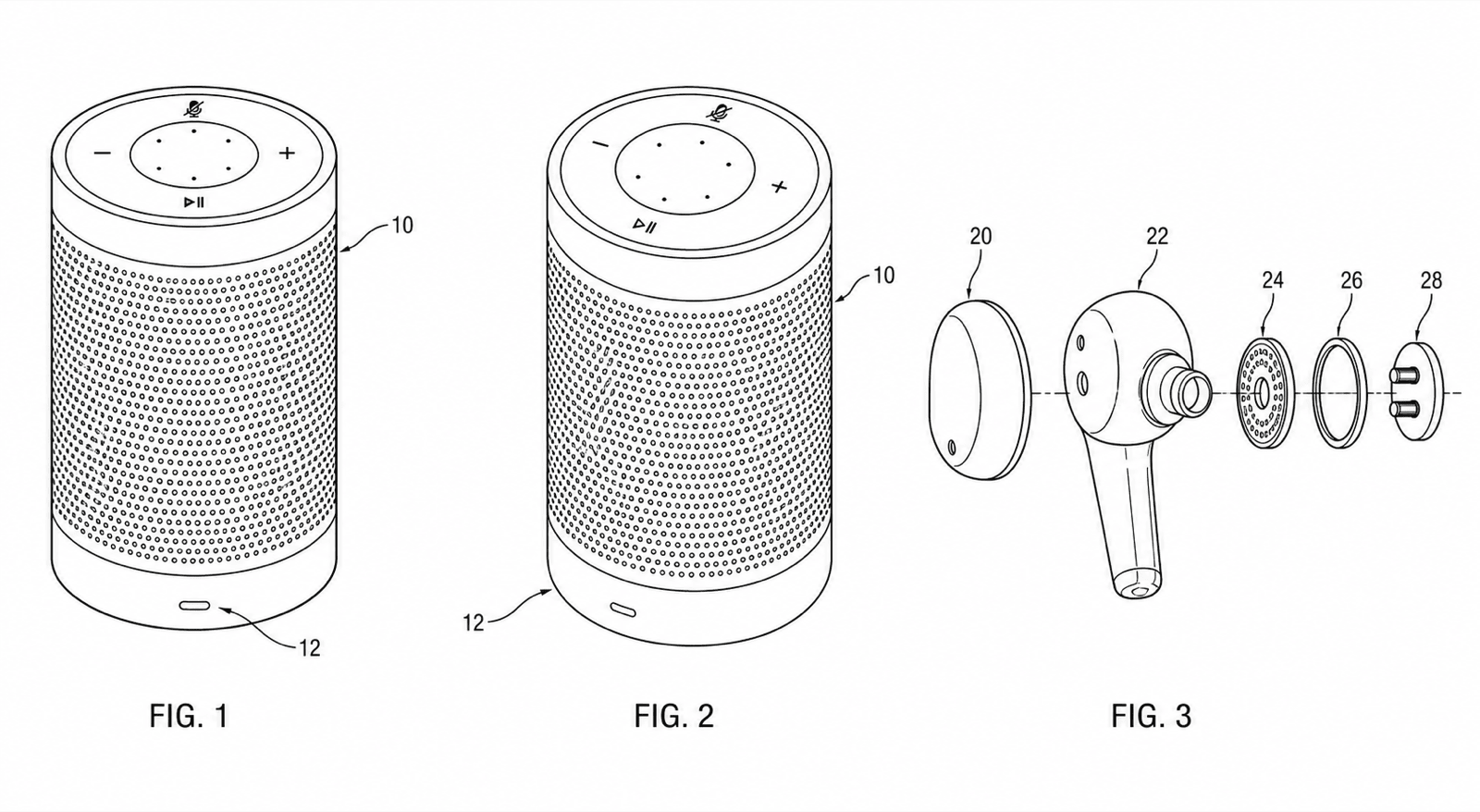
- Design (appearance) claims → a consistent multi-view set — front, rear, both sides, top, bottom, perspective — with solid lines for claimed surfaces and broken lines for disclaimed ones.
- Utility (structure) claims → exploded views with numbered components; electronic system claims → block diagrams that include the battery and power path.
- Keep the design set and the utility set separate — different rules, different line conventions — and render mesh and texture as line patterns, never grayscale shading.
Consumer electronics figure examples
Each example is a fictional invention. Open one to pre-fill the generator with the prompt.
Which figures support which claims
Consumer devices file under both design and utility practice — each claim type maps to its own figures.
1
Appearance claims → design multi-view sets
Front, rear, left, right, top, bottom, and perspective views that agree geometrically, with solid lines claiming the ornamental design and broken lines showing disclaimed environment.
2
Structural claims → exploded views
Housing, frame, battery, board, speaker driver, and fasteners separated along a dashed alignment axis, every component numbered for the assembly recitation.
3
Electronic system claims → block diagrams
Processor, radios, sensors, display driver, charging circuit, and battery as labeled blocks — including the power path the claim recites.
4
Interaction and charging method claims → flowcharts
Pairing, wake-on-gesture, and charge-management methods as numbered steps mirroring the claim language.
5
Detail claims → enlarged partial views
Hinges, latches, charging contacts, and seal geometry enlarged where the claimed feature is legible.
Consumer electronics drawing mistakes that cost office actions
The failure patterns specific to device figures — design and utility alike.
Design views that disagree
A control button at different heights in the front and side views is a fatal inconsistency in a design filing — the views must describe one geometric object.
One drawing set for both filings
Reusing numbered utility figures in the design application (or unnumbered design views in the utility case) breaks both rule sets. Each filing gets its own figures.
Grayscale mesh and texture
Speaker grilles, fabric, and knurling rendered as gray fills draw objections. Draw texture as line patterns — stippling, repeated line work, conventional surface shading lines.
Block diagrams without the power path
If the claim recites a battery, charging circuit, or power management, omitting them from the block diagram leaves claim elements without support — the most common gap in device system figures.
Outsourcing device figures vs. PatentFig AI
A product launch needs design and utility sets at once — exactly when per-figure billing and vendor queues hurt most.
Drawing service
PatentFig AI
Design view sets
Priced at the top of the per-sheet range
Generated as a consistent six-plus-view set
View-to-view consistency
Manual checking across views
Views generated from one model of the product
Design + utility from one product
Two jobs, two invoices
Both sets from the same photos or CAD
Texture handling
Hand-drawn line patterns at hourly rates
Mesh and fabric converted to line patterns
Launch-deadline turnaround
7–10 days per round
Minutes; revisions same day
Cost
$100+ per sheet, design sheets at the top
Free tier; $50/mo · 500 credits · ~50 figures (~$1 each)
PatentFig AI is the better fit when
- A product launch needs design and utility sets generated from the same CAD or photos
- Design views must stay geometrically consistent with each other across six-plus views
- Mesh, fabric, and knurled textures must convert to compliant line patterns
- Filing spans USPTO, CNIPA, EPO, JPO, or KIPO design and utility practice
Other channels fit better when
- A high-stakes design family needs a specialist’s certified view set
- You need photorealistic marketing renders — the opposite of patent line art
- The claims are pure software UI — screen-figure practice has its own conventions
Industry guide
Consumer electronics drawings FAQ
Cover the look and the works
Design view sets, exploded views, and block diagrams from the same product photos — generated, numbered, and checked.
Related tools and guides
Design patent drawing software
Consistent front/rear/side/top/bottom/perspective views.
Exploded view generator
Structural claims supported by exploded device views.
Design drawing examples
Sample design view sets from the examples gallery.
Figure checker
Validate figures against office rules before filing.
Patent block diagram generator
Device electronics as labeled, numbered blocks.
Guide: design patent drawings
Broken lines, shading, and the required views.