Patent Length Explained: How Long Utility, Design & Provisional Patents Last (2026)
How long does a patent last? Compare US, EPO, PCT, CNIPA, JPO & KIPO patent length rules: 20-year utility terms, 15-year design patents, the 20+1 provisional strategy, original 17-year terms, and figure requirements.
TL;DR: Patent length depends on both patent type and jurisdiction: a modern US utility patent (and European patent) lasts 20 years from its earliest effective non-provisional filing date, a US design patent lasts 15 years from the grant date with no maintenance fees, and a provisional patent application gives a 12-month "Patent Pending" priority window that does not eat into your 20-year utility clock. Because you cannot switch a design filing into a utility filing (or add missing internal views later without losing priority), choosing the right term strategy — and generating the matching figure set in PatentFig AI — has to happen before Day 1.
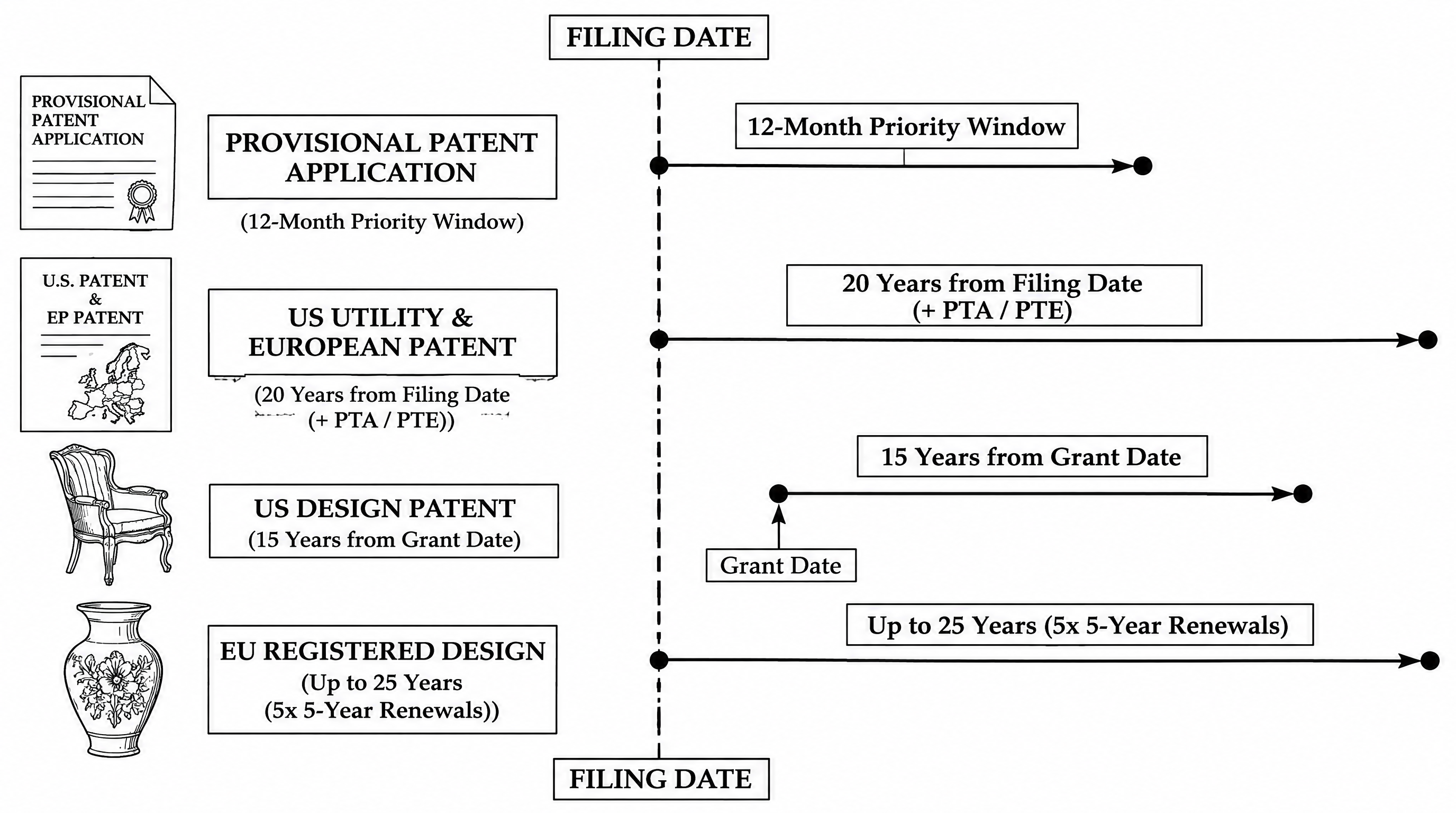
Patent Length at a Glance: US, EPO, PCT, CNIPA, JPO & KIPO
When founders or product counsel search how long does a patent last, the biggest mistake is confusing the filing date trigger (used for utility and plant patents) with the grant date trigger (used for US design patents), or overlooking renewal fees that terminate a patent early.
| Patent / Design Right | Maximum Patent Length | Clock Starts On | Maintenance / Renewal Fees | Extensions Available? |
|---|---|---|---|---|
US Utility Patent (35 U.S.C. 154) | 20 years | Earliest effective US non-provisional (or PCT) filing date | Due at 3.5, 7.5, and 11.5 years after grant | Yes — PTA (USPTO delay) & PTE (FDA review, up to 5 yrs) |
US Design Patent (35 U.S.C. 173) | 15 years (14 yrs if filed before May 13, 2015) | Date of grant | None ($0 maintenance fees) | No PTA; design patents run strictly from issue date |
US Provisional Application (35 U.S.C. 111(b)) | 12 months (pendency only; never grants alone) | Provisional filing date | None | Non-extendable 12-month deadline (narrow 2-month petition only if unintentional delay) |
US Plant Patent (35 U.S.C. 161) | 20 years | Earliest effective non-provisional filing date | None | PTA & PTE eligible |
| European Patent (EPO / Unitary) | 20 years | European or PCT international filing date | Annual annuities starting Year 3 | SPC up to 5 years (+6 months pediatric) for pharma/agrochemicals |
| EU / UK Registered Design | Up to 25 years | Application filing date | Renewed every 5 years | Capped at five 5-year periods (25 years total) |
| PCT International Application | 30 / 31 months (filing conduit, not a granted patent) | Earliest priority date | National-phase annuities apply per country | National patents entered via PCT last 20 years from the PCT filing date |
| CNIPA (China) | 20 yrs (Invention) · 10 yrs (Utility Model) · 15 yrs (Design) | Chinese or PCT filing date | Annual fees | Patent term compensation & drug PTE (since 2021 Patent Law) |
| JPO (Japan) & KIPO (Korea) | 20 yrs (Invention) · 25 yrs (JP Design) · 20 yrs (KR Design) | National or PCT filing date | Annual registration/annuity fees | Prosecution-delay & pharma extensions available |
The "20 + 1 Year" Provisional Strategy: Why Provisional Time Is Bonus Runway
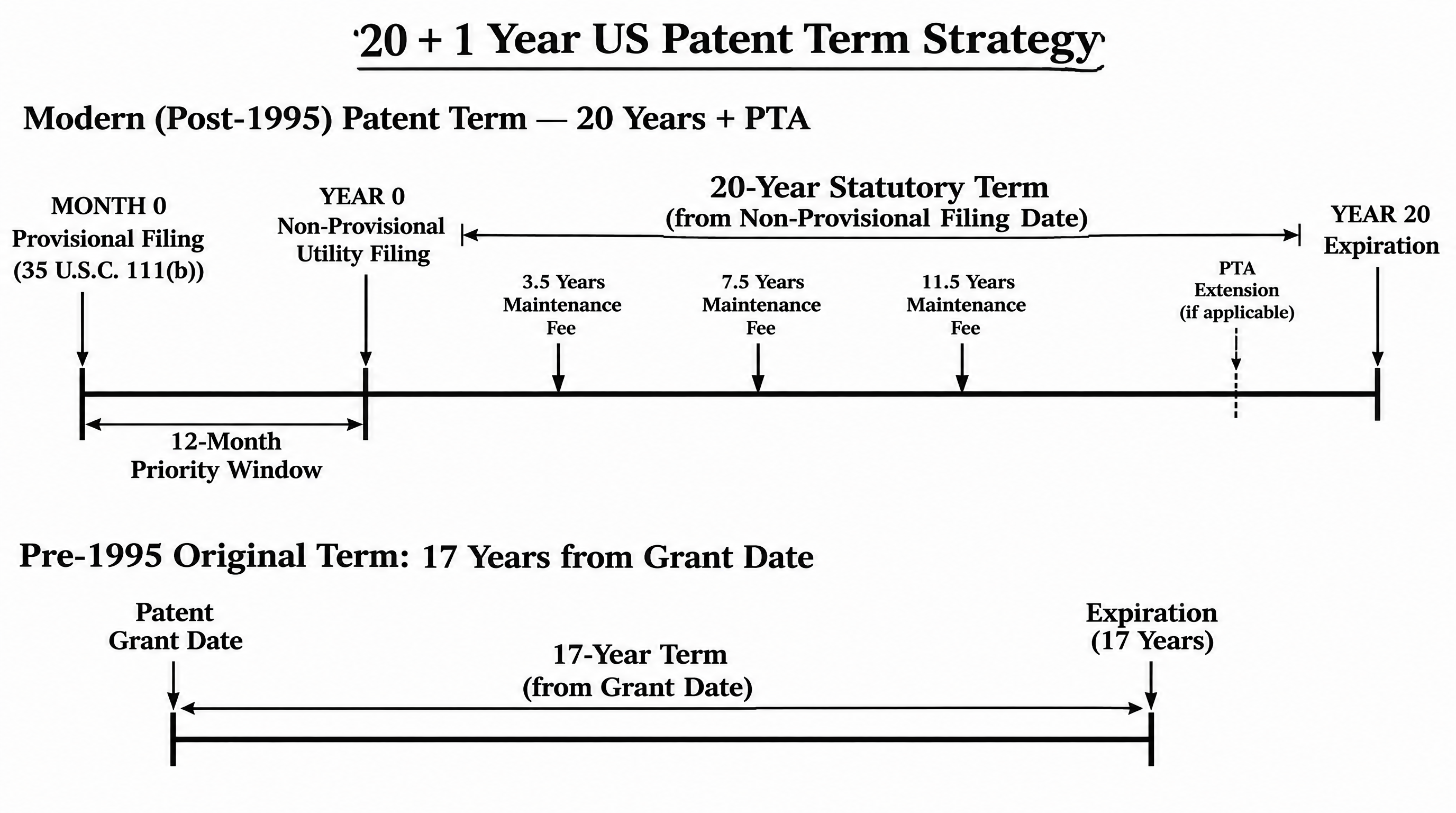
Under 35 U.S.C. 154(a)(3), claiming domestic priority to a US provisional application does not count toward the 20-year utility patent calculation.
Here is how hardware and software teams use that rule in practice:
- Day 0 (Provisional Filing): You file an enabling specification and complete provisional patent drawings. You immediately gain "Patent Pending" status and a priority date recognized worldwide under the Paris Convention.
- Month 12 (Non-Provisional / PCT Conversion): You file your US non-provisional utility application (and/or PCT international application) claiming benefit of the Day 0 provisional. Only today does the 20-year patent length clock start ticking.
- Year 21 from Day 0: Assuming you pay the USPTO maintenance fees at 3.5, 7.5, and 11.5 years after grant, your utility patent expires 20 years from Month 12 — giving 21 total years from your original provisional priority date.
Critical caveat for PCT filers: While a US provisional application does not start the 20-year clock, a PCT international application is treated as a non-provisional filing date. Entering the US national stage from a PCT starts your 20-year term on the PCT filing date (not the 30-month national-stage entry date). And remember: provisional applications do not exist for design patents under 35 U.S.C. 172.
Original Patent Length: Why Older US Patents Lasted 17 Years (and Early Historical Terms)
Researchers reading older citations often search original patent length and see conflicting numbers across eras:
- 1790 Patent Act (the very first US patent law): Up to 14 years from grant, with occasional Congressional extensions to 21 years.
- 1861 to June 7, 1995 (the classic "17-year patent"): For well over a century, US utility patents ran for a flat 17 years from the date of grant. A handful of applicants exploited this rule with "submarine patents" — chaining continuation filings in secrecy for decades so the 17-year monopoly started only after an entire industry matured.
- June 8, 1995 GATT / URAA Transition: Congress switched US utility patents to 20 years from the earliest effective non-provisional filing date (applications pending on or filed just before June 8, 1995 received the greater of 17 years from grant or 20 years from filing).
- Patent Term Adjustment (PTA) vs. Patent Term Extension (PTE): Today, if the USPTO takes longer than 14 months to issue a first Office Action or longer than 3 years total to grant a patent (minus applicant delays), PTA automatically adds days back onto the front page of your patent (
(**) Notice: Subject to any terminal disclaimer, the term of this patent is extended or adjusted under 35 U.S.C. 154(b) by 342 days).
Length of a European Patent vs. National Filings
Searches for length of european patent involve two distinct layers of European IP:
- European Patents (EPO — EPC Article 63): A European patent (whether validated country-by-country in states like Germany, France, and the UK, or registered as a Unitary Patent across participating EU member states) lasts 20 years from the filing date. Unlike the USPTO’s post-grant 3.5/7.5/11.5-year milestones, the EPO charges annual renewal fees starting in Year 3 even while the application is still pending examination.
- European Design Protection (EUIPO Registered EU Design): While a US design patent runs a single flat 15 years from grant, an EU Registered Design starts with a 5-year term from filing and can be renewed four times in 5-year blocks up to 25 years total — giving consumer-product brands a full quarter-century of visual exclusivity if their drawings were filed cleanly.
How Patent Length Shapes Your Drawing Strategy Before Day One
Choosing between a 20-year utility patent, a 15-year US / 25-year EU design right, or filing both on the same day directly dictates what your figures must show:
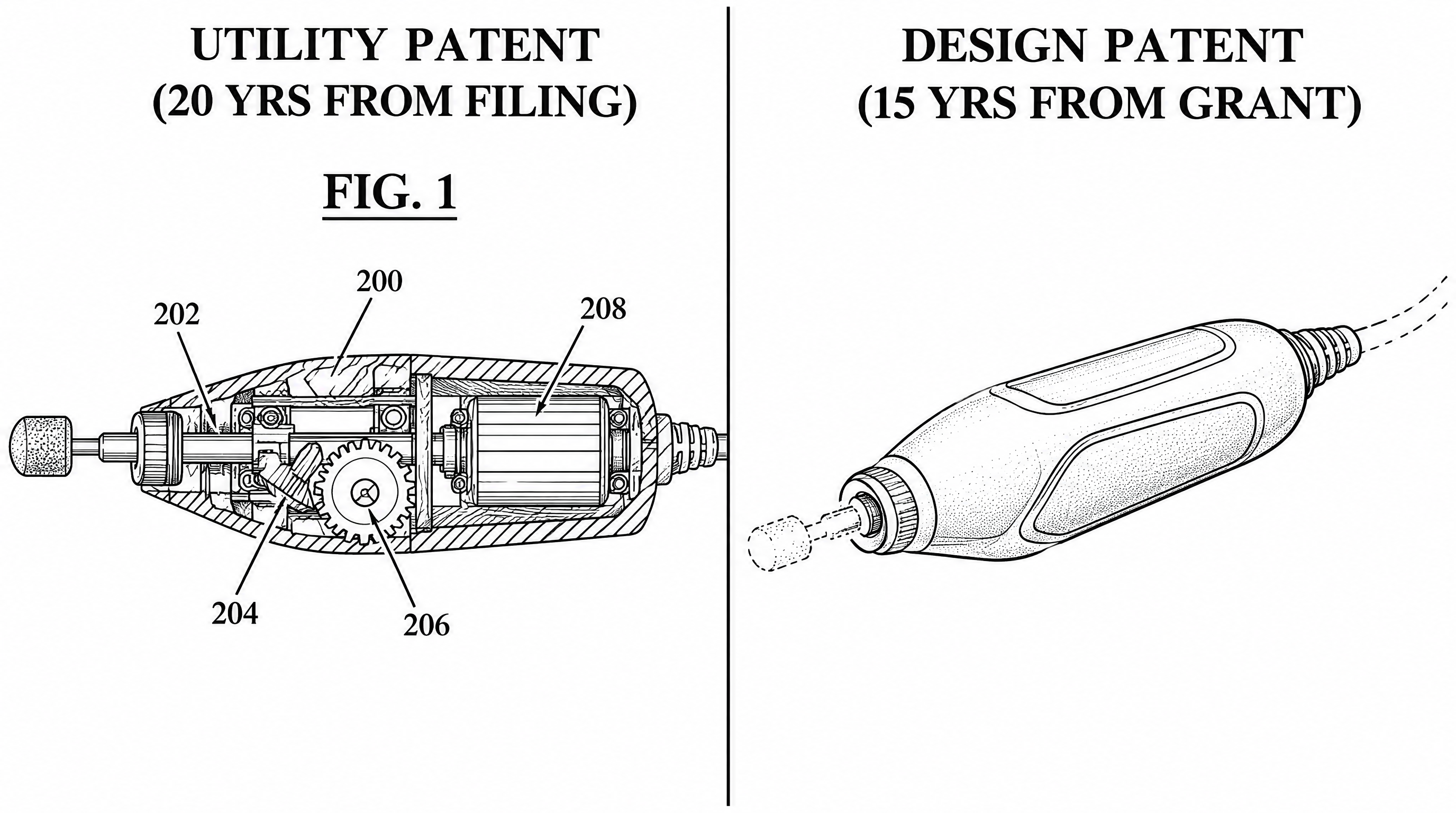
- Utility Patent Figures (20-Year Functional Runway): Built to teach how the invention works across multiple embodiments. Use the Utility Patent Drawing Generator to create perspective assemblies, cross-sections, exploded views, and method flowcharts with editable reference numerals (
100, 102, 104) that support broad functional claims. - Design Patent Figures (15-Year US / 25-Year EU Visual Runway): Here, the drawings are the claim. Every solid line narrows scope; every broken (dashed) line disclaims non-essential ports or environment. Use Design Patent Drawing Software to prepare consistent 7-view orthographic sets (
front, rear, left, right, top, bottom, perspective) checked against patent drawing requirements. - Provisional Day-Zero Figure Sets (Locking the +1 Year Window): A provisional priority date is only worth as much as what your Day-Zero figures actually disclose. If an internal latch or circuit block is omitted from your provisional drawings and added at Month 12, that feature gets only the later Month-12 priority date.
Ready to lock in your priority date with clean, compliant figures? Open PatentFig AI to turn sketches, CAD screenshots, product photos, or claim drafts into USPTO-, EPO-, and CNIPA-ready patent drawings in minutes.
Frequently Asked Questions
What is the standard patent length in the United States?
In the United States, a utility patent and a plant patent each last 20 years from the earliest effective non-provisional US filing date (subject to maintenance fees for utility patents and any Patent Term Adjustment or Extension). A US design patent filed on or after May 13, 2015 lasts 15 years from the date of grant with zero maintenance fees.
Does a provisional patent count against the 20-year utility patent length?
No. Under 35 U.S.C. 154(a)(3), a domestic provisional patent application establishes a 12-month priority window without starting the 20-year utility patent term clock. Filing a provisional application first and converting within 12 months gives up to 21 years from your initial priority date.
Why did older US patents have an original patent length of 17 years?
Before June 8, 1995, US utility patents lasted 17 years measured from the date of issue. Congress amended 35 U.S.C. 154 under the Uruguay Round Agreements Act (GATT) to harmonize US patent length with the international 20-years-from-filing standard and eliminate submarine patent delays.
What is the length of a European patent?
A European patent granted by the European Patent Office (EPO) — including a Unitary Patent — has a maximum patent length of 20 years from its filing date, kept in force through annual renewal fees (annuities). Supplemental Protection Certificates (SPCs) can add up to 5 years for regulated pharmaceuticals and agrochemicals, while EU Registered Community Designs can be renewed every 5 years up to 25 years.
Can I extend patent length after a patent expires?
Ordinarily no — once maintenance fees lapse without timely reinstatement or the full statutory term ends, the invention enters the public domain permanently. Narrow statutory extensions exist only during prosecution delays by the USPTO (Patent Term Adjustment under 35 U.S.C. 154(b)) or FDA regulatory review delays (Patent Term Extension under 35 U.S.C. 156).
Author

Categories
More Posts
Utility Patent Drawings vs Design Patent Drawings: Legal Scope, Terms & Figure Rules (2026)
Utility patent vs design patent explained: compare what each protects, 20-year vs 15-year US patent terms, why there is no provisional design patent, broken lines, reference numerals, and required views.
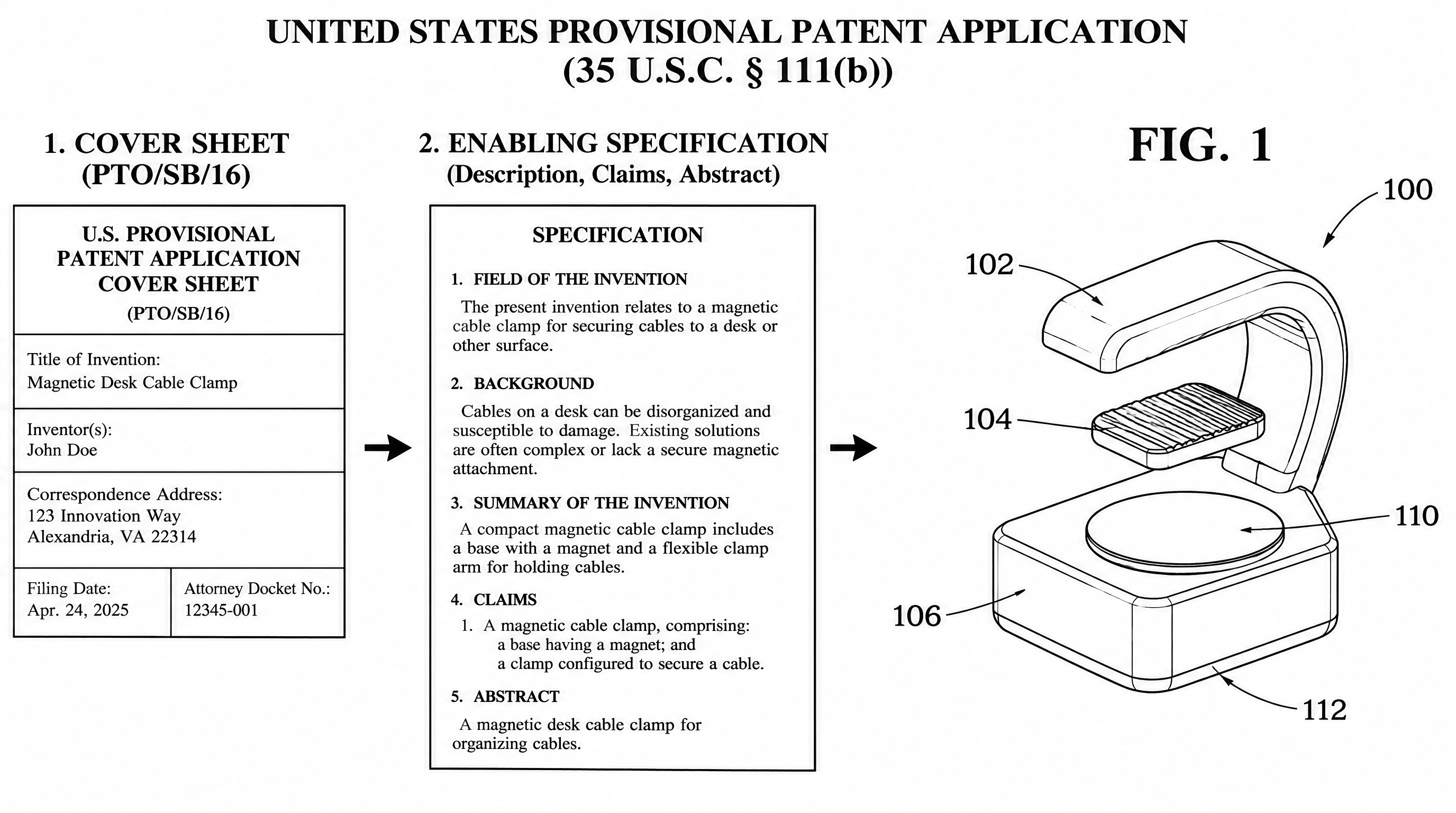
Provisional Patent Example: Annotated Sample, Cover Page & Drawings (2026)
Provisional patent example with annotated cover page (PTO/SB/16), enabling specification, sample claim, and 3-figure provisional patent drawings under 35 U.S.C. 111(b).
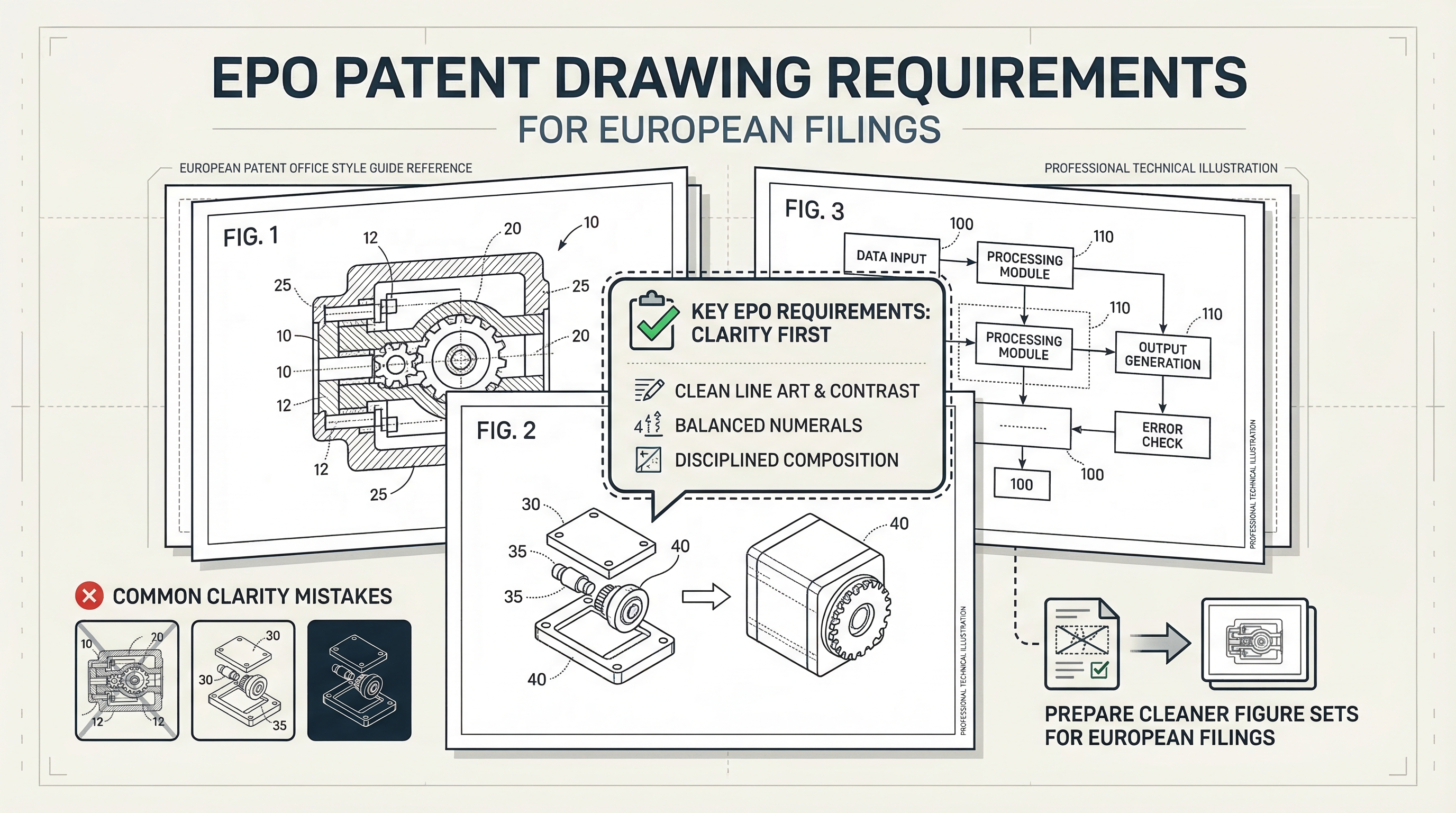
EPO Patent Drawing Requirements 2026: European Filing Guide and Checklist
EPO figure rules, common clarity mistakes, and a disciplined workflow for European patent filings. Learn when USPTO-ready figures fail at the EPO. 2026 guide.
Newsletter
Join the community
Subscribe to our newsletter for the latest news and updates