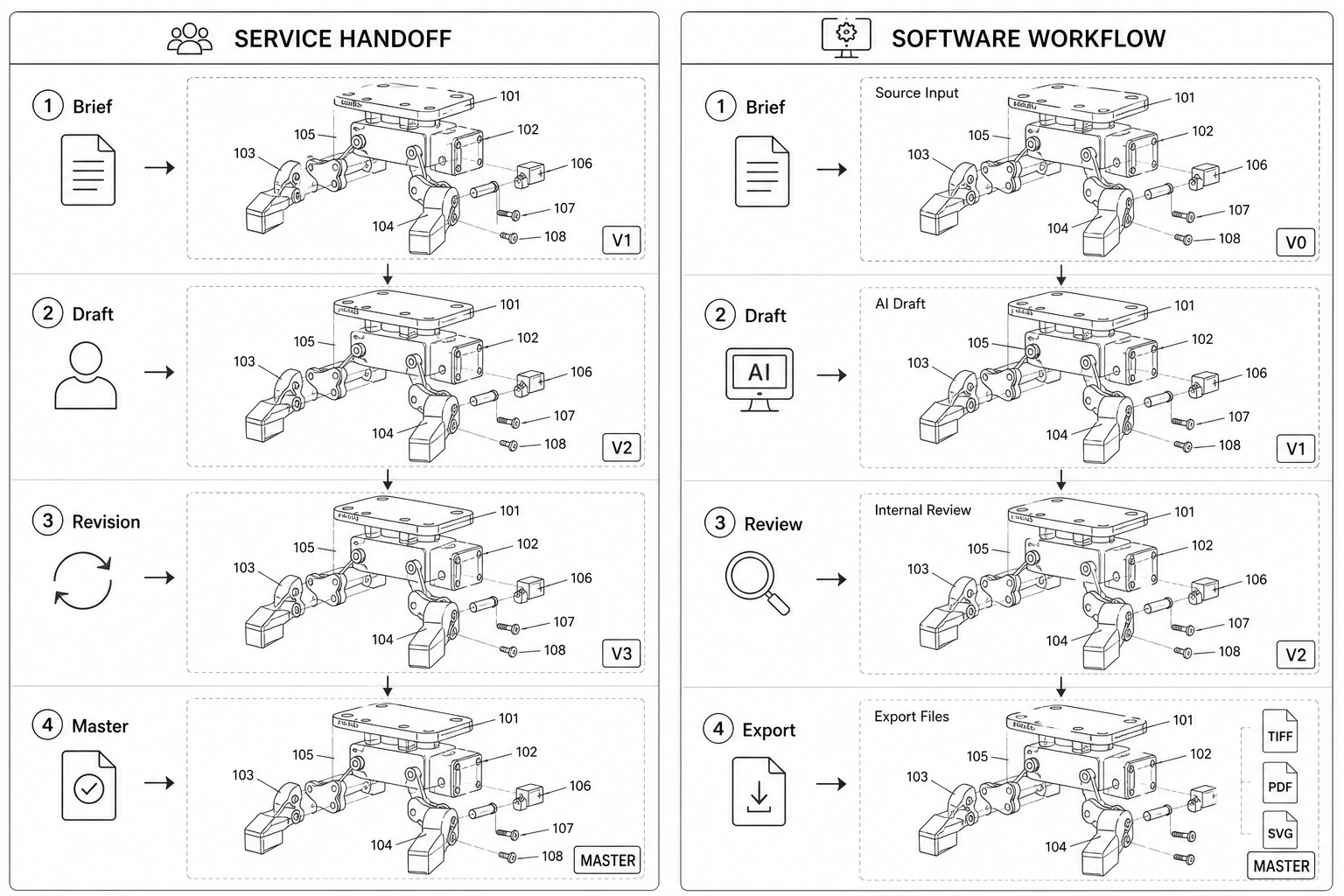
Patent Illustrator vs AI Software: Cost, Quality, and When to Use Each
Compare AI patent illustration software with traditional patent illustrator services on cost per figure, turnaround time, quality, and when each option fits.
TL;DR: Illustrator services charge $40–$200 per figure with 5–10 business-day turnaround; AI software produces comparable utility line art in minutes for a flat monthly fee. For most IP teams the answer is a mix — software for routine utility figures, human illustrators for complex design-patent sets and assemblies. For the quick decision version, see services vs software.
For most of the last thirty years, "patent illustration" meant hiring an illustrator. The shop produced TIFF files from inventor sketches or CAD output, charged $40-200 per figure, and turned around in five to ten business days. That model still exists and still works. What changed is that AI patent drawing software now produces comparable utility patent line art in minutes for a fraction of the cost — and the question for an IP team is no longer "which service" but "what mix."
Compare the two routes side by side. Open PatentFig AI, or read the dedicated comparison at patent illustration services vs software.
Cost per Figure: The Direct Comparison
Figures with comparable scope — a single utility patent view, line art, reference numerals, A4 sight rectangle — priced across typical providers in 2026:
| Provider type | Cost per figure | Typical turnaround | Revisions included |
|---|---|---|---|
| Boutique patent illustration firm | $50-150 | 3-7 business days | 1-2 rounds |
| Large IP-firm in-house illustrator | $150-400 (loaded cost) | 2-5 business days | Unlimited |
| Freelance illustrator (Upwork/Fiverr) | $20-100 | 2-7 days | 1-2 rounds, varies |
| Specialized patent illustration agency | $80-250 | 5-10 business days | 2-3 rounds |
| AI patent drawing software (PatentFig AI tier) | $2-10 (amortized subscription) | Minutes per figure | Unlimited |
| AI software + human review hybrid | $30-100 | Hours | Unlimited AI, 1-2 human rounds |
For a 10-figure utility patent drawing set:
- Boutique firm: roughly $500-1500
- Large IP firm in-house: $1500-4000
- AI software: $20-100 in subscription time
- Hybrid: $200-600
The order-of-magnitude difference is real. The relevant question is what each route trades for that price.
What You Get for the Higher Price
A human patent illustrator brings four things that AI software does not consistently deliver yet:
- Judgment about ambiguous source material. A faint sketch with overlapping embodiments needs interpretation. A skilled illustrator asks the right clarifying questions; AI tools take the input literally.
- Consistency across a set. Six orthographic views of a design patent must show the same product at the same scale with consistent broken-line discipline. Humans match figure-to-figure; AI tools generate each view independently and need human reconciliation.
- Cross-section accuracy. A cross-section through a complex assembly requires understanding what is solid, what is hollow, where seals sit, where bores go. AI tools handle simple cross-sections; complex assemblies need a person.
- Accountability on the file. Some firms and clients want a named human responsible for the drawing set. AI output does not satisfy that requirement.
What You Lose at the Lower Price
AI software at $2-10 per figure trades:
- Speed for consistency. Each figure generated independently can have small differences in line weight, scale, or perspective that a human would smooth out.
- Volume for reliability. AI tools work most of the time. The fraction that needs to be redrawn or substantially edited is a real cost — measure in cleanup time, not generation time.
- Iterations for judgment calls. Unlimited regeneration sounds like a feature but turns into a problem when the user does not know what "correct" looks like. A human illustrator's first draft is usually closer to filing-ready than the AI's tenth iteration.
- A real reviewer. AI does not push back when an instruction is wrong. A human illustrator will ask why the cross-section is on a different plane than the perspective implies.
Turnaround Time: Where Software Wins Hardest
The cost difference is large, but the turnaround difference is larger.
- Human illustrator, standard turnaround: 3-10 business days for a typical drawing set, plus 2-3 days per revision round. A figure set delivered on day 1 and revised twice ships on day 14-18.
- Human illustrator, rush turnaround: 1-3 business days at a 50-100% premium. Revisions on the same timeline.
- AI software, base turnaround: Minutes per figure. A 10-figure set can be drafted in under an hour.
- AI software with human review: Hours to one day. The bottleneck is the human review pass.
For filing deadlines under 5 business days, AI is often the only realistic option. For filings with 4-8 weeks of lead time, the cost-vs-quality calculation favors humans more.
Quality Differences You Will Actually See
Side-by-side comparisons of human-illustrator output and AI output, in our experience:
| Aspect | Human illustrator | AI software | Verdict |
|---|---|---|---|
| Line weight uniformity | Excellent | Good, sometimes needs normalization | Human edge |
| Reference numeral placement | Excellent (matches spec) | Mixed — may invent or misplace | Human edge, substantial |
| Contour accuracy from photos | Very good | Very good | Tie |
| Cross-section detail | Excellent for complex assemblies | Good for simple, weak for complex | Human edge |
| View consistency (orthographic sets) | Excellent | Good with explicit prompts | Slight human edge |
| Time to first draft | Days | Minutes | AI edge, massive |
| Cost of revision iteration | Per-round billable | Free | AI edge |
| Output file readiness for filing | Filing-ready | Needs format check | Slight human edge |
| Output file portability (vector master) | Usually delivered as SVG | Always available as SVG | Tie |
| Confidentiality | NDA-bound illustrator | Encrypted upload, controlled access | Different, both adequate |
The honest summary: human illustration is better at structural and consistency tasks. AI is better at speed, volume, and revisions. The hybrid model captures most of the value of both.
The Hybrid Model: When It Wins
Most IP teams that have used both routes for six months end up at some version of:
- AI for the bulk of the drawing set. Software handles the figures that are straightforward: structural views, block diagrams, flowcharts, photo-derived line art.
- Human for the strategically critical figures. The lead claim figure, the design patent view set, the complex cross-section. The figures most likely to be cited in prior art and amended during prosecution.
- Software for revisions and amendments. Once a figure exists in vector form, amendments are usually a 30-second edit in Inkscape rather than a billable round with the illustrator.
The hybrid typically runs much cheaper than human-only and more expensive than AI-only, but reduces the cleanup cost on critical figures.
Decision Framework
Match your filing situation to the route that fits.
| Situation | Recommended route |
|---|---|
| Solo inventor, provisional patent application | AI software |
| Solo inventor, non-provisional, simple invention | AI software |
| Small firm, low-volume utility filings | AI software with internal review |
| Small firm, high-stakes utility filing | Hybrid (AI bulk, human review) |
| Medium IP department, high volume | AI software with internal review |
| Medium IP department, design patents | Hybrid (AI exterior, human view-set consistency) |
| Large IP department, strategic patent | Hybrid or human-only depending on partner preference |
| Foreign-prosecution amendment | AI software (the original illustrator is often unavailable) |
| Rush filing under 5 business days | AI software |
| Color drawing petition | Human illustrator (the petition is rare enough that experience matters) |
| Medical device with FDA crossover | Hybrid (regulatory consistency requires human review) |
| Pharmaceutical chemistry diagrams | Specialized chemistry illustration service (neither route handles this well) |
What Happens to Patent Illustration Firms
Software does not eliminate human illustration; it changes the mix of work and the pricing model. The boutique firms we have spoken to are reporting:
- Less per-figure work, more per-set work. Clients send the AI draft and ask for cleanup or polish across the set rather than starting from scratch.
- Less rush work. Most rush filings move to software.
- More design patent work. Design patents require broken-line discipline and view consistency that AI tools still struggle with.
- More cross-section and exploded view work. The figures that are hardest for AI become a larger share of human work.
The firms that have adapted to this mix are doing fine. The firms that have not are competing on price with AI tools that are an order of magnitude cheaper.
What to Test Before Switching
If your team is on a human-only workflow today and is considering AI:
- Take a recent drawing set that went to filing successfully.
- Run the same input materials through AI software. Generate the same number of figures.
- Compare side by side. Note the failure modes: numerals, cross-sections, view consistency.
- Measure the cleanup time to bring the AI output to the same quality as the human output.
- Calculate the per-figure cost of (AI time + cleanup time) vs the human invoice.
For most utility patent drawing sets, the AI + cleanup cost is dramatically lower than human-only. For design patent sets and complex assemblies, the cleanup time can push the AI cost closer to the human cost.
The right answer depends on your filing mix. Run the test on your own work product before committing either way.
Next step: Continue with the patent drawing software decision guide, which compares the four operating models by figure type, revision speed, rule checking, and procurement fit.
Author

Categories
More Posts
Patent Illustration Cost in 2026: Real Rates, Hiring vs. Software
What patent illustration actually costs in 2026 — per-figure rates from $25 to $300, revision and rush fees, three worked cost scenarios, and the break-even point where software beats outsourcing.
AI Patent Drafting Tools in 2026: 10 Named Tools, Pricing, and Where Figures Fit
A named-tools guide to the 2026 AI patent landscape — Solve Intelligence, DeepIP, Patlytics, Rowan Patents, PatentPal, IPRally, PQAI and more — with published pricing and an honest look at which ones actually produce patent figures.
Building a Patent Software Stack in 2026: Three Recipes, Real Costs
Three concrete patent software stacks — solo inventor, small firm, in-house IP team — with named tools, realistic monthly costs, the data-flow details that make them work, and a two-week pilot plan.
Newsletter
Join the community
Subscribe to our newsletter for the latest news and updates